
AEO vs SEO for Shopify: What Changes When AI Becomes the Search Engine
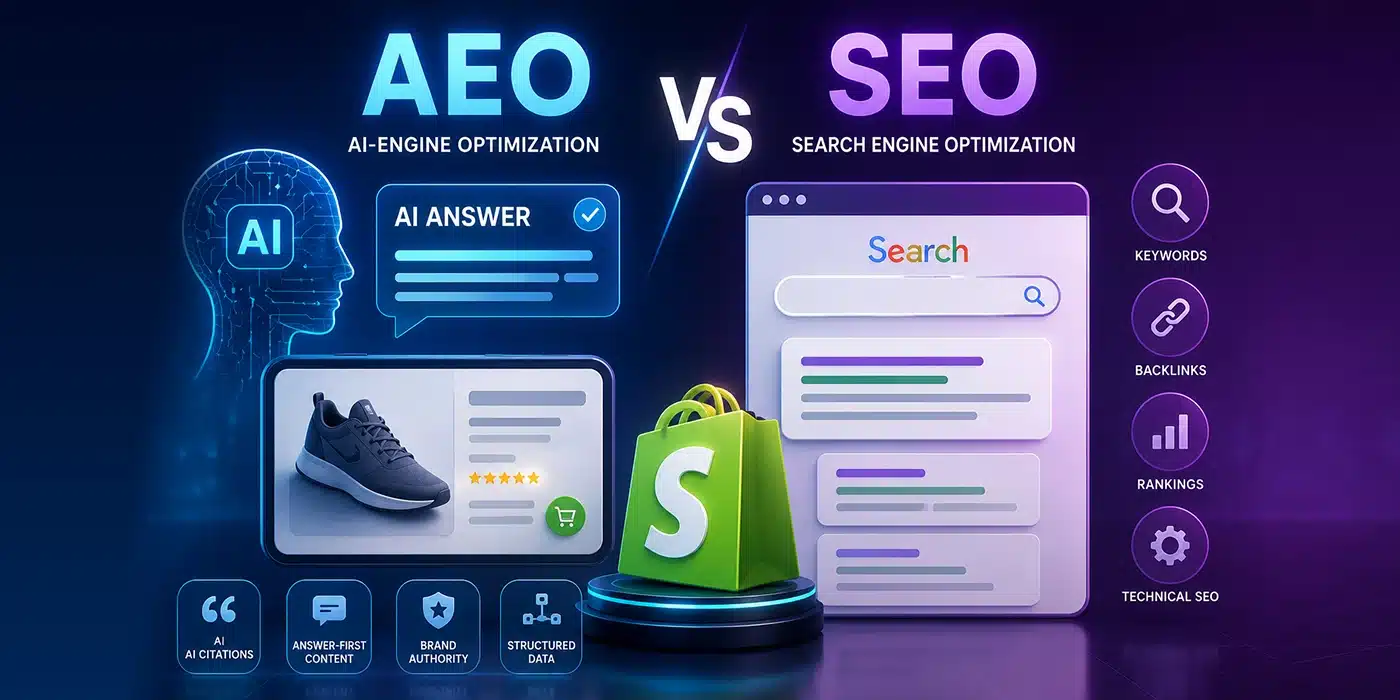
How does answer engine optimization differ from SEO, what stays exactly the same, and where a Shopify store should actually spend.
Open Google and search for almost anything you would actually buy. The ten blue links are still there, but notice what now sits on top of them: an AI Overview that answers the question in a few sentences, with the real results pushed down past the fold. Across ChatGPT, Perplexity, and Gemini, there is not even a list, only the answer. The results page you spent years learning to climb is quietly turning into a paragraph you now have to be quoted in. That one shift, from a page that lists to a page that answers, is the whole reason people cannot stop arguing about SEO versus AEO.
SEO optimizes your store to rank as a link that earns a click. AEO, answer engine optimization, optimizes it to be the answer an AI gives, cited and trusted, whether or not a click follows. They are not rivals. AEO is built on top of SEO, and the stores that win in 2026 do both. What changes is the goal, the shape of your content, and how you measure success.
SEO and AEO, in one line each
SEO, search engine optimization, is the practice of making your store rank in a search engine’s results so a shopper clicks through to your page. It has been the ecommerce SEO playbook for fifteen years: keywords, content, links, and technical health, all aimed at winning a position and the click that follows it.
AEO, or answer engine optimization, is the practice of structuring your store and content so an answer engine, ChatGPT, Perplexity, Google’s AI Overviews and AI Mode, Gemini, can extract it, cite it, and present it as the answer to a shopper’s question. The goal is not the ranked link. It is being the thing the machine says.
Those sound similar, and they share a lot of plumbing. But the difference in goal changes almost everything downstream. Here is the side by side.
AEO vs SEO, side by side
| Dimension | SEO | AEO |
|---|---|---|
| Goal | Rank your page as a link in the results list | Be the answer the AI gives, or one of its cited sources |
| What the shopper sees | Ten links to choose between | One synthesized answer with a few named sources |
| Unit you optimize | The page | The passage, the answer block |
| Primary success metric | Rankings, organic traffic, click-through rate | Citation and mention share, inclusion in the answer |
| Content shape | Depth and keyword coverage, long-form | Answer-first, concise, clearly structured, easy to extract |
| Role of structured data | Helpful | Load-bearing |
| Where you compete | Your position on the results page | The answer itself and its cited sources |
| The click | Earn the click | Often no click at all, so value has to land before it |
| Off-site signals | Backlinks that lift ranking | Reviews and mentions the AI can quote and trust |
| How you measure | Rank trackers and Search Console | Prompt testing, citation tracking, AI referral traffic |
Read down the table and a pattern shows up. SEO is built around a list and a click. AEO is built around an answer and a citation. Same web, same store, different finish line. Now here is what that actually means for the work you do on Shopify.
What actually changes for your Shopify store
You optimize for questions, not just keywords. Shoppers type full buying questions to an assistant, so your content has to match how people actually ask, the qualified, use-case phrasing, not only the two-word terms you tracked in a rank tool.
Answer-first becomes the format. An answer engine rewards the page that states the answer plainly in the first line or two, then elaborates. Burying the answer three paragraphs down is how you rank and still get skipped.
Structured data goes from optional to load-bearing. Product, Review, FAQ, and Organization schema is how a machine reads your facts without guessing. Shopify Catalog supplies a lot of this automatically, but it is still worth validating what is actually on the page, and on a headless or heavily customized build that is a good thing to check with your Shopify development team.
Success stops being only rankings. Position still matters, but the new scoreboard is how often you are named or cited when the relevant questions get asked. You track that by prompting the engines and logging the results, or with free audit tools, not by checking a rank report.
Zero-click changes the deal. When the answer lands inside the assistant, there may be no click at all. So part of the job is delivering value before the click, and part of it is giving shoppers a reason to come to your store anyway, a tool, a configurator, or data they cannot get from a summary.
Off-site reputation becomes an optimization surface. Backlinks still help, but reviews, mentions, and third-party corroboration are what an answer engine quotes and trusts. Your reputation off your own domain is now part of the optimization work, not a nice-to-have.
What does not change
For all the noise about SEO being dead, most of the foundation is shared. A crawlable site, valid structured data, and genuine topical authority serve both disciplines. If an AI crawler cannot reach or read your pages, neither SEO nor AEO will help you, which is the same truth SEO always taught. We dig into that failure mode in our guide on why your store is not showing up in AI answers.
SEO is not being replaced. It is the layer AEO is built on. Shopify’s own guidance is blunt that GEO and AEO do not replace SEO, and that strong SEO fundamentals make AI visibility easier because the engines still lean on search indexes. Your product and transactional pages matter as much as ever, because even when an assistant makes the recommendation, it still has to send the buyer somewhere to purchase, and that somewhere is usually your live product page.
So where should you spend?
The honest answer is both, in proportion to your query mix. SEO keeps doing most of the work on transactional, brand, and navigational searches, the ones where a shopper already knows roughly what they want and is close to buying, and it provides the technical and authority foundation everything else stands on. AEO is the layer for the informational and comparative slice of the funnel, the “which is best for X” and “what should I buy” questions that increasingly get asked to an assistant instead of a search bar.
The good news for Shopify merchants is that much of the SEO foundation is handled for you. Shopify renders content server-side, generates a workable robots.txt, and its Catalog supplies structured product data automatically, so more of your effort can go into the AEO layer: answer-first content, complete schema, and the off-site proof that earns citations. It also helps to know that AEO has a sibling. Where AEO is about being the cited answer, generative engine optimization is about being the brand the AI recommends, and we cover that side in detail in our guide on getting your store recommended by ChatGPT and Perplexity.
Frequently asked questions
See where your store stands across search and AI answers
If you want to know where your SEO foundation is solid and where the AEO gaps are letting competitors win the answer, an AI visibility audit maps both in one pass.
AI Visibility Audit ➞
