
Agentic AI in Retail: Who Is Winning and Where Commerce Leaders Should Start (Growth Files Ep. 7)

Retail has gone from analytics to big data to AI to GenAI. Then, the industry heard a new term: agentic AI. Suddenly, every executive in the room was asking the same questions. How do we change our strategies? What do we actually do with this?
Meanwhile, many retailers are still trying to source one version of the truth across their data. Some are still stitching things together in Excel with VLOOKUPs, the same way they were a decade ago. Forecasting and planning still require a lot of humans in the loop and a lot of manual work. And the pressure to announce an AI strategy keeps growing, whether the foundation is ready for it or not.
This is not a future-state problem. It is happening right now across mid-size and enterprise retailers, from luxury fashion to grocery to electronics.
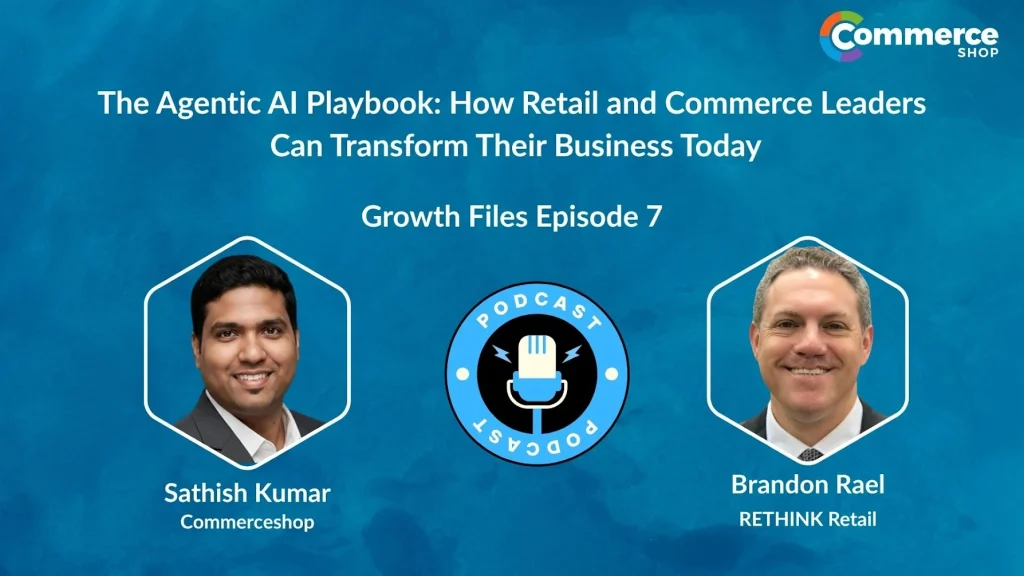
In this episode of Growth Files, we sit down with Brandon Rael, a trusted advisor in AI-driven commerce, supply chain modernization, and enterprise retail transformation. He has led business transformations for Fortune 100 retailers and is recognized as a Global Rethink Retail Industry and AI Expert. His perspective runs through every answer in this conversation: agentic AI is an enabler, not a strategy. The companies that forget that are the ones that fail.

Brandon Rael is a trusted advisor with experience in AI-driven strategy, digital commerce, supply chain optimization, and operational improvement across consumer industries. He specializes in Agentic AI, enterprise modernization, and profit optimization, helping brands modernize operating models and drive business growth.


Sathish Kumar is CEO of CommerceShop, an eCommerce consultancy focused on revenue-first optimization for brands scaling from $2M–$25M. He specializes in AEO, conversion optimization, and helping manufacturers adapt to AI-driven buyer journeys across complex B2B commerce ecosystems globally.
Episode TL;DR
- Traditional AI recommends and waits for humans to act. Agentic AI monitors signals, makes decisions autonomously, and coordinates across systems.
- Louis Vuitton cut overstock by 20% and handles 60 to 70% of routine inquiries with AI agents. Burberry removed $100 million in counterfeit listings in a single year.
- Do not start with a big bang transformation. Start with your data strategy. If your teams are still stitching things together in Excel, agentic AI has nothing clean to work with.
- Any transformation will fail without executive sponsorship and co-creation with the teams that own the processes. Brandon has seen these kill initiatives.
- Customers do not know or care what agentic AI is. They know whether they had a good experience or a bad one.
In this conversation:
- What makes agentic AI fundamentally different from traditional AI and GenAI
- Where real results are already showing up across luxury, grocery, and electronics retail
- The data strategy problem that blocks agentic AI before it can deliver anything
- The risks that come with moving too fast without the right foundation
- How to take a purpose-led approach that earns board confidence instead of creating chaos
- Why executive sponsorship and change management decide whether AI initiatives live or die
The Shift: What Makes Agentic AI Different from Everything Before It
Sathish: Retail has adapted so many initiatives over the years. Why is agentic AI different, and what kind of impact will it have?
Brandon: I’ve always believed and been a big proponent that retail is a blend of the arts and sciences. If you veer too far into the sciences and lose the art, it’s a death sentence for the business and the customer experience. Analytics has always been a core part of the retail operating model. We’ve gone from analytics to big data to AI to GenAI, and then last year at NRF 2025, the big Nvidia and Walmart announcement put agentic AI on the map, and the world shuddered.
So let’s level set. Traditional AI is more about being predictive. It provides recommendations, expects actions, and requires human intervention to execute. Agentic AI is all about business outcomes. It continuously monitors signals, looks for triggers and opportunities, makes contextual decisions autonomously, and coordinates across systems and functions in ways that weren’t possible a couple of years ago.
But you have to set the guardrails, set the expectations, and ensure it’s actually driving continuous improvement. It’s still in the very early stages. Agentic AI is an enabler. It’s a tool. It’s there to help drive better decision-making, with humans in the loop, navigating and driving the decisions ultimately.
The difference in practice:
The distinction matters because it changes what retailers can expect from their technology investments. Traditional AI tells a merchant planner what might happen. Agentic AI can anticipate customer needs, identify opportunities across the supply chain and merchandising, scan multiple platforms, compare prices across competitors, bundle discounts and promotions, and serve as an autonomous assistant for a merchant.
It can execute transactions autonomously, making recommendations to ensure inventory is optimized and assortment planning is where it needs to be across all channels.
The Biggest Pain Point: One Version of Truth
Sathish: What is the biggest pain point that agentic AI can address?
Brandon: In my entire career, going back to my days as a merchant planner, the biggest challenge was sourcing one version of the truth. Having integrated data sources that can actually drive better merchandising decisions instead of blind decisions across the retail value chain.
What I see now is agentic AI enabling seamless integration between all the systems: sourcing, product development, merchandising, assortment planning, inventory management, open to buy, replenishment, and supply chain fulfillment down to the store level. It is the integration and the ability to execute and drive business outcomes that I see as the real power of agentic AI.
Ultimately, it has to be driven toward meeting the customer’s needs and empowering frontline workers to serve those customers seamlessly across channels, whether it’s social commerce, e-commerce, or in-store. There has to be one consistent experience.
The end-to-end integration Brandon describes is what most retailers have been trying to achieve for years through ERP rollouts and platform consolidation. The difference now is that agentic AI can sit on top of existing systems and create that fluid exchange of information without requiring a multi-year overhaul. But only if the underlying data is ready for it.
Real Results: Louis Vuitton, Burberry, and What the Leaders Did Differently
Sathish: Has agentic AI already made a real impact in retail?
Brandon: It has. I can list off examples. I won’t quote Walmart and Amazon; they’re definitely at the forefront. But I want to look at this from a fashion and luxury retail lens because the innovation there is very impressive.
Look at what Louis Vuitton and Dior have done with clienteling. They’re empowering store associates to leverage digital platforms and real-time autonomous styling. They’ve been able to reduce overstock by 20% by driving core categories that are actually selling through AI-driven demand sensing. Conversion rates are up to 15% better for store associates using clienteling tools. And Louis Vuitton is using AI assistants that now handle 60 to 70% of routine customer inquiries, while human advisors handle the more complex challenges.
Burberry is leveraging agentic AI and digital twin capabilities to look at the product lifecycle and authenticate products, using agents to help remove $100 million of counterfeit listings in a single year. That leads to repeat customers, trust and confidence in the brand, and a 10% lift in sales.
And even though 80 to 85% of sales, probably 90% in luxury, still happen in physical stores, when the customer can look online and see with 90% accuracy that the inventory exists, there’s a lot more confidence to visit the store on a Saturday.
What these results show:
Brandon presents these as real outcomes already being delivered: reduced overstock, higher conversion, fewer counterfeits, increased trust, and a measurable lift in sales. In each case, the AI is empowering store associates and improving the customer experience at the same time. And even with 80 to 90% of luxury sales still happening in physical stores, the digital experience is driving confidence that gets customers through the door.
Agentic AI is already delivering measurable results for luxury, grocery, and electronics retailers. This conversation breaks down where the wins are happening and what commerce leaders need to get right before they start.
▶ Listen to the full episode on Spotify to hear Brandon’s complete breakdown of how retailers should approach agentic AI adoption.
The Dawn of True Conversational Commerce
Sathish: Are these personalized experiences and AI assistants what agentic AI looks like for retailers?
Brandon: In a way, yes. We’re at the dawn of true conversational commerce. Conversational commerce has been around for a while with social commerce, but it wasn’t really a human-like experience. Now you’re able to chat in real time with an agent. It used to be a bot; now we call it an agent. And it actually knows and recognizes you as a loyal customer. It knows your tastes and preferences and can answer your questions dynamically. 99% of the time, it can take care of simple inquiries and drive more personalized experiences.
But again, the arts and sciences. You don’t want to veer too far into the sciences. You want to attract the luxury customer to the store, to the showroom, to the showcase store in New York City. That real deep experience and relationship with the store associate. Conversational commerce was coming up for a while, and now it’s emerging as a stronger capability.
Where the discovery process is changing:
Brandon sees the customer discovery process shifting significantly. Gen Z and Gen Alpha are leveraging TikTok and Instagram for their search needs. Customers across all segments are increasingly using ChatGPT and Claude for conversational searches rather than traditional keyword searches on Google. The paradigm has changed in how brands get recognized and how they can get the attention of customers.
The Data Problem That Blocks Everything Else
Sathish: Should retailers do a complete transformation to adopt agentic AI, or is there a different approach?
Brandon: The days of large-scale ERP transformations are obviously over. It’s almost a legacy mindset to spend two or three years working on a large-scale change across your backend OMS, merchandising, point of sale, and supply chain systems. Retailers don’t have the luxury of doing that anymore. Agentic AI autonomous agents can sit on top of existing integrations and drive faster decision-making and workflows across all your systems.
But the challenge is whether your tech stack is already integrated or it’s a spaghetti tech debt situation where you’re not sure where your data sources are. I always recommend taking a step back and looking at data strategy and data governance. What is the quality of your data? Is it clean? Is it integrated? Is it one version of the truth?
Because the old saying goes: garbage in, garbage out. If you’re not feeding the LLMs and agentic systems with the right data, you should pause and get your data strategy in place first.
Sathish: What if a retailer is still using on-prem databases and the data is not in the cloud?
Brandon: That’s a challenge for sure. You need data stewards and change champions. Data is really a product. If you don’t have one source of truth that you have trust and confidence in, it’s very difficult to think about agentic AI. You can start with a limited subset of data and pilot it in a lab or a few stores. But you’re introducing significant risk with an enterprise rollout of data that’s not accurate, not timely, not integrated, and not governed.
I suffered for a decade in retail, trying to pull all kinds of sources of data together from Excel, from downloads and uploads, and VLOOKUPs. Here we are in 2026. There are still many organizations that operate in Excel.
Brandon’s recommendation: data strategy first, then business outcomes.
Once the data foundation is in place, the next step is a cross-functional executive workshop to identify and prioritize where the biggest pain points are: supply chain, store operations, personalization, merchandising, and procurement. There are many areas where agentic AI can remove costs and drive intelligence for better decision-making. But none of it works if the data underneath it is fragmented.
Supply Chain: The Number One Place to Start
Sathish: Where should agentic AI play the biggest role in retail operations?
Brandon: My background is supply chain as well. The autonomous ability for agentic AI to optimize and transform a supply chain into a repeatable, executable engine that can be more predictive with demand signals, trigger replenishment down to the store level, trigger open-to-buy sequences, and ensure availability in warehouses. Integration of the supply chain is critical. That’s the biggest element for growth.
Store operations from a labor planning perspective can be automated. IoT devices at the store level can detect when items are low on stock and order replenishment. Electronic shelf labels can handle price changes. Fleet management, the trucks and planes, the sequencing around that. And the whole merchandising and assortment planning cycle. Humans are a critical part of the loop, the merchants and planners and the collaboration with product development. That won’t go away. But access to data and insights will be a critical part of the operating model going forward.
Sathish: What kind of growth can companies expect from agentic AI in supply chain and inventory planning?
Brandon: It has to align with the North Star goals of the company. Be honest and realistic about revenue increases and margin improvements. I’ve always recommended that companies pick a small segment of their assortment and determine where we are today and what improvements we want to achieve. Through data science and ROI modeling, you can determine where efficiencies can be gained and where uplift in conversion rates and incremental margin can be achieved.
You can see up to 10% improvement in some categories, maybe 5% in others. It’ll range based on the category and the kind of retailer. But you need to be realistic. It has to be a collaborative co-creation with the executives. Consultants coming in from the outside who don’t know the business as well might misstate growth opportunities. It has to align with the company’s North Star goals.
Agentic AI in retail is not about replacing humans with autonomous systems. It is about giving merchants, planners, and store associates the real-time data and intelligence they have never had before. This conversation covers where the real opportunity is and what has to be in place before any of it works.
The Risks Nobody Should Ignore
Sathish: Where can agentic AI go wrong?
Brandon: There are a couple of risks. The quality of data is probably the biggest. The second is hallucinations, being led down a path you didn’t expect. You have to check the quality of results. And then there’s cybersecurity. Customer data, credit card information, personal information. We’ve seen hacks and hijacks. Retailers need security and resiliency with guardrails to give customers confidence that their information is protected.
There’s also the bright and shiny object problem. Everyone sees things at NRF and ShopTalk and feels the pressure to jump on agentic AI. But there are so many fundamental and foundational things that need to be achieved before you can do that.
Three risks Brandon flags:
- Data quality: If the data feeding the agentic systems is not accurate, timely, and governed, the outputs will be unreliable. This is the most common and most fundamental risk.
- Hallucinations and output quality: Agentic systems can generate confident but wrong recommendations. Retailers need to verify the quality of what comes out, not just what goes in.
- Cybersecurity and customer trust: Exposing more customer data through LLMs introduces risk. If a customer is compromised, they leave the brand. The security and resiliency foundations have to be set before any agent touches customer data.
Where to Start: Purpose-Led, Not Pressure-Led
Sathish: If a mid-sized company wants to implement agentic AI, where should they start?
Brandon: Start with core principles and what you represent in the market. Don’t take a big bang approach. Take a very purpose-led approach. What are the business outcomes you want to achieve? What KPIs do you want to drive: revenue growth, EBITDA improvement, cost savings, better customer experiences?
Identify a pilot. You need board approval in many cases, and unless you have a cost savings play or something that will drive ROI in a measurable timeframe, I’ve seen these AI conversations go to a halt. Set expectations: if we take this agent and optimize the supply chain, we should expect X results in one year, two years, five years. Set those expectations to the board.
The execution strategy has to take into account how the company operates. What’s the culture? Who are the key sponsors? Who are the change agents? How does it impact roles? What training and organizational change management do you need? You don’t want to introduce so much operational risk that it disrupts the company and causes chaos and churn. You want it to flow organically.
Brandon’s crawl-walk-run approach:
Throughout the conversation, Brandon returns to the same implementation philosophy. Don’t try to transform everything at once. Find the biggest friction point, whether it’s supply chain, reverse logistics, clienteling, or personalization. Pilot there. Build a measurable case. Then scale. The companies that try to make a blanket statement about leveraging agentic AI without answering the how, when, and why are the ones that stall.
Why Executive Sponsorship Makes or Breaks Every AI Initiative
Sathish: Where have you seen agentic AI implementations fail?
Brandon: I’ve seen cases where AI has been embedded without the right sponsorship from the business teams that own the processes. They didn’t do the due diligence to ensure alignment from the start. The teams didn’t own it and never embraced it.
Starting that relationship early with executives and change sponsors is critical. When a director or VP is engaged, aligned, and sees the value, it extends throughout the organization. They’ll help the company embrace the change.
Any transformation will fail unless you have the sponsorship, the co-creation, the collaboration needed. I’ve seen it fail time and time again, even before agentic AI became a thing. As humans, we resist change unless we fully understand the why and the purpose behind it, the how, and the impact on our role and our team. If those questions aren’t answered, it fails.
Brandon has seen this pattern repeat even before agentic AI became a thing. When the teams that own the processes do not own the initiative, they do not embrace it. When people do not understand the why, the purpose, and the impact on their role and their team, they resist the change. Those fundamental questions have to be answered or the initiative fails.
The Metrics That Actually Matter
Sathish: What metrics should companies track for agentic AI?
Brandon: If you look at revenue only, you’re shortsighted because it doesn’t tie back to profitability. EBITDA and gross margin are critical. From an inventory perspective, look at conversion rates, in-stock rate, and inventory turns. Look at pricing and promotional strategies. What is the profitability of a price change? Are you doing it dynamically? What promotions are driving demand?
Ultimately, it’s about revenue growth and profitability. But fundamentally, you can also drive cost savings and unlock value that will help brands reinvest those savings into more innovations that drive growth and better experiences.
The metrics Brandon recommends:
Revenue growth and EBITDA are the top-line measures. But the operational metrics underneath them are what tell you whether agentic AI is actually working: conversion rates, in-stock rates, inventory turns, promotional effectiveness, and the profitability impact of dynamic pricing. As Brandon puts it, looking at revenue only is shortsighted because it does not tie back to profitability.
What Commerce Leaders Must Do Now
Agentic AI in retail is not failing because the technology is immature. Where it stalls, it stalls because organizations jump on the pressure to adopt without fixing their data, aligning their executives, or defining what success actually looks like.
The retailers who win will not be the ones with the most advanced AI. They will be the ones who match technology investment with organizational readiness and tie every initiative to a clear business outcome.
Here is where to start:
1. Fix your data strategy before you touch agentic AI
Is your data clean, integrated, governed, and accessible in real time? Is it one version of the truth? If your teams are still pulling from multiple systems and working in Excel, that is the first problem to solve. Agentic AI sits on top of your data. If the foundation is fragmented, everything built on it will be unreliable.
2. Define business outcomes before choosing tools
What KPIs are you trying to move: EBITDA, conversion rates, in-stock rate, cost savings? Pick a specific, measurable target tied to your company’s North Star goals. If you cannot articulate the expected outcome in one sentence, you are not ready to buy.
3. Start with the supply chain
Product availability is everything. Whether the customer finds you through ChatGPT, TikTok, or walks into the store, if you cannot confirm inventory with confidence, the experience fails. Supply chain optimization is the highest-ROI starting point for most retailers.
4. Take a crawl-walk-run approach
Find the biggest friction point in your operation. Pilot there with a clear ROI case and a measurable timeframe. Build the case for the board. Scale what works. Do not attempt a big bang transformation.
5. Secure executive sponsorship before you start
Any transformation will fail without the sponsorship, co-creation, and collaboration of the business teams that own the processes. Get a director or VP engaged, aligned, and visibly advocating from the beginning. If the people who own the process do not own the initiative, it will not be adopted.
6. Set guardrails for data quality, hallucinations, and security
Verify the quality of what comes out of agentic systems, not just what goes in. Ensure cybersecurity and data governance are in place before any agent touches customer information. Customers will leave a brand over a single data breach or bad experience.
7. Measure beyond revenue
Track EBITDA, gross margin, conversion rates, in-stock rates, inventory turns, and promotional profitability. Revenue alone does not tell you whether agentic AI is driving sustainable growth. Build the measurement framework before the initiative launches, not after.
Is Your eCommerce Brand Actually Ready for AI?
Brandon’s message is clear: if your data is not clean, your systems are not integrated, and your teams are not aligned, agentic AI has nothing solid to work with. Most brands skip this step. That is where the expensive mistakes start.
Commerce Shop’s AI Readiness Audit evaluates your current operations, tech stack, data quality, and workflows to identify where AI can deliver real impact for your business.
- AI opportunity discovery across your customer journey and operations
- Data health and activation review
- Tech stack fit and automation potential
- Clear, actionable roadmap tailored to your growth goals
Get your free AI Readiness Audit →
No one-size-fits-all. No fluff. Built for eCommerce.
Keep the Conversation Going
This is Episode 4 of Growth Files by CommerceShop, inside stories and strategies from manufacturing and B2B leaders navigating the shift to AI.
Also Watch ←

