
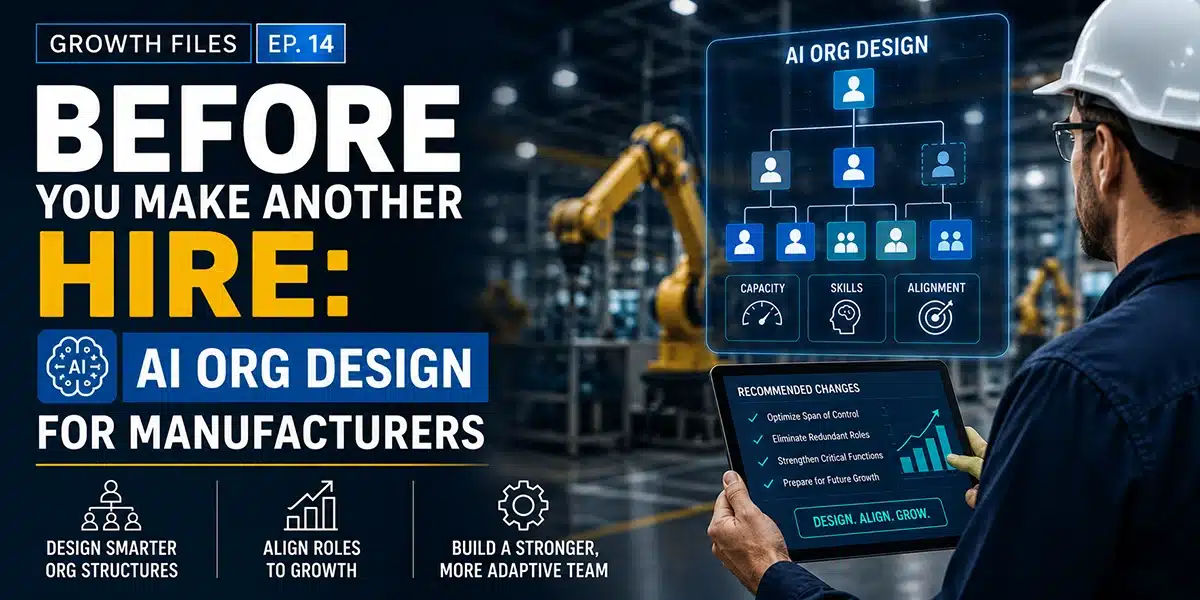
A plant manager opens a requisition for five new hires. The roles were written for a world that no longer exists: a trainer who builds curriculum by hand, a coordinator who chases documentation, an engineer who spends half a day answering the same questions every week.
Cheryl Thompson wants one question asked before that requisition moves. Which of those tasks, processes and outcomes could shift to AI, and which people already on staff should be doing something more valuable?
In Episode 14 of Growth Files, Sathish Kumar speaks with Cheryl Thompson, who started at Ford in the dish room, came up through tool and die into global manufacturing leadership at Ford and American Axle, and now advises manufacturers on where AI fits. Her tagline frames the conversation: leadership is the skill, AI is the edge.
Episode TL;DR
- •Most manufacturing jobs were designed for a pre-AI world, so the org chart deserves a review before the next requisition.
- •Redesign elevates people into mentorship, innovation and growth work. Headcount stays.
- •A 40-year expert answering the same questions all day is a knowledge capture opportunity.
- •Governance and use cases move together. Excitement about use cases funds the unglamorous work.
- •One leader reported a $500,000 license hit to a single cost center.
- •Without a policy, people use AI anyway, on personal phones, beyond any guardrail.
- •Companies fall into three buckets, and the locked-down bucket carries the most risk.
- •Freed-up time needs a plan, or it silently refills with more work.
In This Conversation
- 1.How a Self-Described Non-Technical Engineer Found AI
- 2.Why the Org Chart Comes Before the Next Hire
- 3.The Ask Greg Problem: Capturing Expertise Before It Walks Out
- 4.Start at Home: How AI Glasses Actually Develop
- 5.Governance, Pilots and the Cost Nobody Budgets For
- 6.What AI Employees Look Like in Practice
- 7.Culture: Psychological Safety and a Risk-Averse Industry
- 8.What Employees Are Actually Afraid Of
- 9.Three Buckets: Where Manufacturers Sit Today
- 10.Building a Company Brain
- 11.Where a Leader Should Start Tomorrow
About the Guests
Guest

Cheryl Thompson, Founder of Cheryl Thompson Advisory Group and founder of CADIA. More than 30 years across Ford Motor Company and American Axle & Manufacturing, moving from a tool and die apprenticeship through manufacturing engineering, global prototype operations and leadership. Six Sigma Black Belt, MBA from Michigan State. She advises manufacturers on modernizing documentation, training and workflows with practical AI.
Host

Sathish Kumar Mariappan, CEO and Co-Founder of CommerceShop and host of Growth Files. Sathish leads a revenue-first eCommerce consultancy for brands scaling from $2M to $25M, focused on conversion optimization, answer engine optimization and B2B manufacturing commerce.
How a Self-Described Non-Technical Engineer Found AI
Cheryl planned on studying computers in the 1980s. She got pregnant out of high school instead, waitressed for a while, and applied to Ford on her father’s suggestion. He was an engineer there. She started in the dish room and moved into an apprenticeship for a trade she knew nothing about.
Cheryl: “It was for tool and die, and I had no idea what a tool and die maker did. I thought I was going to make tools and dye them. Then I learned what it was all about, and I loved it. Being able to make something made me feel so powerful.”
That hands-on start led into engineering, and the pattern held: curiosity about the next thing, then learning it by doing. AI arrived the same way. She points out that manufacturing has run AI for years already in vision systems, machine monitoring and quality. What changed was the arrival of large language models, which put the technology within reach of someone who describes herself as lacking a deep technical background. A few weeks with ChatGPT, Claude and Gemini plus some formal training was enough.
Cheryl: “It was like I was wearing these new AI glasses, seeing opportunity everywhere. The only limit is your imagination on what AI can do.”
Between Ford and her advisory practice she founded CADIA, a membership organization that reached 70 members, built around leadership, culture and the people the industry overlooks. That thread carries directly into how she talks about AI adoption today, which she frames as no one left behind. Plenty of people opt out on the grounds that they are not technical, and her counter is that accessibility is exactly the point: the tool levels a playing field that used to favor whoever could parse a dense specification fastest.
The barrier sits lower than most people assume. An engineer who leaned toward the people side of the work could have used AI to make a technical document legible and asked follow-up questions privately. Speed of comprehension is the point, since organizations have to move faster than the change around them.
Why the Org Chart Comes Before the Next Hire
The central argument arrives early, and it starts with a design flaw. Most manufacturing roles were written for a pre-AI world, which means a meaningful share of the daily work in them is now automatable.
Training is the cleanest example, because every manufacturer needs it and most build it the same way: a team of trainers writing single point lessons, work instructions and course material by hand. The alternative Cheryl describes keeps one person accountable for the standard and hands the production work to AI.
Cheryl: “Now you can have an AI that does that, and your people are the ones with the judgment that understand what training needs to happen.”
The exercise is deliberately mechanical. Take the work chart, identify the tasks, processes and outcomes currently done by people that could shift, and then decide where those people go instead. That second half is where she separates this from a cost-cutting program.
Cheryl: “I’m not talking about getting rid of the people. We need the people. In manufacturing it’s so hard to find talented people. It’s about elevating them to other things like mentorship, innovation, growth.”
That distinction changes the economics. In an industry facing a skilled-labor shortage, headcount reduction solves the wrong problem. Redeployment addresses the real one, since the constraint on most plants is experienced judgment more than available hands.
Sathish makes it concrete: a manager walks in asking for five more people. What should run through a CEO’s head? Cheryl’s answer is that an AI strategy belongs in place first, defining which tasks, outcomes and processes are moving, because the answer changes what role you are actually hiring for. A vacancy for a curriculum designer becomes a question about whether the company instead needs a strategist who can make the AI curriculum designer significantly stronger.
One client engagement shows what that swap unlocks. Their power lockout training was a decade old, advertised as four hours, and took two and a half to deliver.
Cheryl: “We’ve got a mismatch here. I was able to make that training more substantial, modernize it, make sure it was up to speed on the latest standards. Once they saw that, they started thinking about other training opportunities they could develop and sell.”
The same engagement produced a second idea. Power lockout work requires ECPL placards, and placards are exactly the kind of document where small human errors slip through. Running each one past an AI checker first, then a human reviewer, catches what a tired set of eyes misses.
So a vacancy for a curriculum designer turns into a strategist role, a modernized course, a new revenue line, and a quality check on a compliance document. None of it appears if the role gets filled as written.
The Ask Greg Problem: Capturing Expertise Before It Walks Out
The clearest illustration comes from someone who worked for Cheryl. Greg was the surface finish expert with 40 years of experience, and a large share of his week went to answering the same questions from everyone who needed him.
Cheryl: “If I could have taken all of that knowledge in Greg’s head and put it into an AI, the Ask Greg AI for surface finish, I can now free Greg up to mentor younger engineers and help them understand all those things that aren’t written down.”
The pattern extends past technical expertise into how leaders think. She had a boss named Phil whose questions she learned to anticipate, and she would pressure-test her own presentations against them before walking into a room. Colleagues who lacked that model walked in unprepared for questions she considered obvious. A Phil workspace answers the same need: what would he ask, and where is this argument thin.
Two things happen at once here. The expertise becomes durable and queryable, surviving a retirement that would otherwise take four decades of pattern recognition with it. And the expert moves into mentorship, which is how the unwritten knowledge actually transfers. Manufacturers with an aging workforce have a narrowing window on the first, and the second justifies the exercise on its own.
Watch the Full Conversation on YouTube
The six AI systems built for a manufacturer, the governance sequence, and the prompt structure Cheryl teaches leaders.
 Watch on YouTube →
Start at Home: How AI Glasses Actually Develop
Sathish raises the obvious objection: manufacturers treat AI as a technology problem for the computer team. The counter is to start somewhere with no stakes, which in this case was a house.
Cheryl had recently consolidated two homes and finally had everything organized. Rather than let that fade, she opened ChatGPT in voice mode and walked the entire house narrating what was where. Every room, every drawer, every bin, the garage, the crawl space.
Cheryl: “ChatGPT put it into a searchable spreadsheet. I didn’t have to create the spreadsheet. Then I put that on the back end of a custom GPT, and now I open it up and say, where is that soup pan I was looking for? I called it Where’d I Put That.”
The jump from a kitchen to a plant floor is short. A small shop with no enterprise inventory system has the same problem at a different scale, and a tool crib is a house with more expensive contents.
Repetition changes how a person frames problems. After enough use, the reflex when hitting friction becomes a question about whether AI can help, and that reflex is what she means by the glasses. The practical entry point is a to-do list: find the tasks that drain energy, the repetitive ones people openly dislike, and start there.
For leadership teams with no time and a tight budget, the same advice scales to a twenty dollar starting point, with one setting worth changing on day one.
Cheryl: “If you’re going to work with AI, get a paid account, and in the settings turn off that use my data to train the model. You want to protect yourself.”
From there the highest-leverage first move is connecting AI to email and calendar for a daily briefing: what conflicts are coming, what needs preparation, and where the schedule has been stacked badly. She mentions going to answer an email recently and finding the draft already written.
Personal use also builds the skill that matters most on a plant floor, which is knowing when the output is wrong. AI hallucinates and sounds confident doing it, and judgment about when to push back comes from hours of use, never a policy document.
Governance, Pilots and the Cost Nobody Budgets For
Asked where a manufacturing CEO should begin, the answer starts with a committee built from people who are already curious. Every company has early adopters, and the ones volunteering are the ones to recruit.
Governance moves first because of what happens in its absence.
Cheryl: “If companies don’t have a policy in place, people could be hiding in the bathroom using ChatGPT on their phone. We want those guardrails established so customer data is protected. People know what is proper use, what is improper, what data should never go in there.”
Sathish pushes on the sequencing, since governance feels restrictive while use cases generate energy. Cheryl’s answer is that both move together, with the use cases doing the motivational work. Excitement about a specific opportunity is what gets people to sit through the unglamorous policy conversation. And the risk is concrete: she has heard of teams outside enterprise tooling plugging things into CRMs, which is where trouble starts.
Then the line item most manufacturers have yet to model. Pricing across the major platforms is still moving, and nobody knows whether current rates hold. Cheryl works across Claude, ChatGPT and Microsoft Copilot because her clients are split across all three, and Copilot alone has already shifted to usage-based billing on part of its stack.
Cheryl: “I was talking to a leader in a company and he said, yeah, I’m looking at like a $500,000 cost hit to my cost center because of all of these licenses.”
Pilots follow, along with an honest retrospective covering what worked, what failed and what would change, and then a plan to replicate the wins across similar cases. Cost belongs on that list from the start.
What AI Employees Look Like in Practice
Cheryl’s own setup is the clearest answer to what an AI employee actually is. She builds in Claude, and notes the equivalents: an agent in Copilot, a gem in Gemini, a custom GPT in OpenAI. She calls them workspaces.
Her marketing workspace functions as a copywriter for LinkedIn posts and newsletters, and one automated skill searches for speaking opportunities every Monday morning. Building it took iteration. She loaded website copy, testimonials, top social posts and her values into the back end, asked for ten blog ideas, picked one, requested a 300-word draft, and then spent real time telling the system what she would never say and rewriting the custom instructions until the tone held.
Others cover sales and leadership. The sales workspace takes a call transcript and returns an assessment of how the call went, and it carries a library of objections. The leadership one holds her team’s StrengthsFinder, Kolbe and Myers-Briggs profiles, which turns it into a rehearsal partner before a difficult conversation.
Cheryl: “Claude was like, you should say this, but you’re not going to because you don’t like conflict.”
That is the framing that gives the concept its name. She previously employed someone to find speaking opportunities and someone else to write copy. Those functions now run as configured workspaces she manages.
Operations has its own patterns. Design agents can hold past FMEAs, failure mode and effects analyses, and surface what a designer might be missing. A workspace loaded with lessons learned becomes a pattern-matcher for engineering changes, answering the question of what should be verified before a change goes through.
The manufacturing translation is direct. A quoting workspace holds past estimates, proposals and pricing, so a new RFQ starts from precedent. The six areas built for manufacturers are training, onboarding, knowledge transfer, documentation, shift communication and program execution. Onboarding suits an industry with high turnover, since the first 30, 60 and 90 days, the buddy’s role and the early signs somebody is struggling can all live in one place. A human stays in the loop throughout.
The Freed-Up Time Problem
Most AI business cases skip what comes next. Cheryl learned it by running six or seven initiatives at once and finding her own brain unable to keep up.
Cheryl: “All that free time I made available, I was just filling it with more work.”
Purchasing and supply chain make the clearest case: strip out the paperwork and negotiation overhead and what remains is time for relationships, where the durable value has always been. Capacity released with no plan gets absorbed by whatever is loudest, and the organization books an efficiency gain while the work quietly expands. Naming the destination in advance, whether mentorship, innovation or revenue work, converts saved hours into something a CFO can see.
Listen to the Full Episode on Spotify
The audio version includes the Ask Greg story, the three buckets framework, and the prompt structure for solving a plant-floor problem.
Listen on Spotify →Culture: Psychological Safety and a Risk-Averse Industry
Asked which of the six systems delivered the biggest impact, the answer moves to the conditions that let any of them work. Expect a slowdown at the start, because these systems need training the same way employees do, and mistakes are part of the process.
Two cultural traits predict how that goes. The first is whether people can make a mistake and say so.
Cheryl: “If I have a culture without a lot of psychological safety, it’s going to be more difficult to implement AI, because mistakes will be made. If people are afraid of making a mistake or they can’t push back on the status quo, we’re going to have a challenge.”
The second is risk appetite, and here manufacturing has a specific inheritance. The industry has always been risk averse and dislikes change, which shows up in the reflex every quality investigation starts with: what changed?
That observation is worth sitting with, because the instinct is a feature. An industry that treats change as the prime suspect keeps parts in tolerance. Introducing a probabilistic tool into that environment asks people to hold two instincts at once. Structure matters too, since top-down hierarchies move differently from distributed ones, and both need accounting for before a rollout.
What Employees Are Actually Afraid Of
Sathish puts the fear directly. If people believe an AI employee is coming for their job, why would they train the system that replaces them?
Cheryl’s starting position is that the question of whether to engage has already been settled. The genie is out of the bottle, the toothpaste is out of the tube, and it keeps coming regardless. What follows from that is a reframe worth carrying into a town hall.
Cheryl: “The doing of the tasks, that’s never the value. The value is in the judgment, and AI can help us get to that judgment quicker.”
She puts the career risk plainly too: the threat is less about AI taking a job and more about someone who knows AI taking it. That framing reassures while staying accurate, because repetitive execution is what moves and judgment is what stays and gets more valuable.
On whether training should precede rollout, the answer is unambiguous. People need to understand the tool, understand the risks, and have team conversations where they share what they tried and what failed. Her benchmark for effort is memorable.
Cheryl: “I always say if you’re not ready to throw your computer out the window, you’re not trying hard enough.”
The piece most programs miss sits alongside formal training: a standing forum where people talk about it. A training module transfers technique, and a room where people admit what went wrong transfers the harder lesson about when to distrust the output. She flags one more failure mode, which is companies that treat AI as a reason to keep assigning more work until people are overloaded.
Three Buckets: Where Manufacturers Sit Today
Cheryl declines to name companies and offers a segmentation instead. The leading group has governance, training and use cases in place, is actively upskilling, and has moved on to tying prompts, agents and skills back to ROI. The middle group is still working the problem, building governance, modeling cost, and mapping where AI belongs.
The third group has done nothing and locked everything down, and that is where she sees the most exposure.
Cheryl: “That’s when I think there’s a bigger risk, because people are going to use it underground anyway.”
The third bucket is counterintuitive for any leader who reads restriction as caution. Locking the tools down produces unmanaged use on personal devices, with no visibility into what data left the building. A written policy plus an enterprise account carries less risk than a prohibition nobody follows.
Building a Company Brain
Sathish asks whether every organization should build its own brain, given how much institutional knowledge sits in a few heads. Cheryl runs two herself, one personal and one for the business, and thinks every company should aim there while acknowledging the difficulty scales with size.
Her answer for large organizations is to start at the function level. Ford has manufacturing engineering, product development, operations and purchasing, and purchasing alone is a workable first target: gather the standards, the specifications, the operating procedures, and build the brain on that scope only.
Cheryl: “Make that brain just on that, so the organization can use it and improve it over time.”
One function at a time is the right unit of work. A purchasing brain has bounded scope, a clear owner, and a definition of done a team can reach, which makes it a credible pilot with a reusable pattern for the next function.
She also flags the discipline that keeps this off a treadmill: chasing every bright shiny object is its own failure mode, and stability has to be engineered into a program while the tools change weekly.
Where a Leader Should Start Tomorrow
Asked for one piece of advice, the answer skips technology and goes to the problem. Start with the biggest pain in the business, and give AI enough context to be useful about it. Her worked example is scrap that has climbed from 1 percent to 5 percent with no obvious cause, and the prompt structure follows four parts:
1) Give it a persona. A quality expert who has solved this class of problem and saved companies millions over the years.
2) Give it the context. What the numbers were, what they are now, and everything already ruled out.
3) Make a specific request. Three things to look at and change today that will drop the scrap rate.
4) Invite questions back. Close with a request for any clarifying questions before it answers.
Voice mode beats typing here, since more context produces better output and talking is faster. A second exercise takes about a minute: tell AI your company and your role, and ask for three unfair advantages it can give you.
On what changes over five years, the answer is a posture. Things she would have called impossible six months ago are shipping now, so the discipline is to treat it like math class and avoid falling behind.
One structural prediction does come through, and it favors the reader running a smaller shop. Cheryl’s own experience as a small business owner is that tools she once found impenetrable, Notion among them, became usable once AI was embedded in them.
Cheryl: “These smaller companies, because they have less restrictions, because they are more innovative, they are going to lap the bigger companies that are not moving as fast.”
Fewer approval layers and less legacy tooling turn into faster cycles. On where leadership fits once the systems run, she returns to her tagline: energy, judgment and relationship skills still decide outcomes, and the human belongs at the front with AI behind it.
Your AI Org Design Checklist
Start with the first three. They cost a week and tell you how much of the rest applies.
- •Pull your open requisitions and mark which tasks in each could shift to AI today
- •Name the early adopters already using AI in your building and put them on a committee
- •Write the policy: approved tools, prohibited data, and who to ask
- •Identify your Greg, the expert whose knowledge lives in one head, and scope a capture project
- •Model 12-month license and usage cost across every tool your teams touch
- •Pick one function and build its brain: standards, specifications, operating procedures
- •Decide in advance where freed-up hours go, and put it in writing
- •Ask AI for three unfair advantages in your role, then test the best one this week
Manufacturing AI FAQ
What is AI org design? Reviewing the org chart against what AI can now do before adding headcount. Tasks, processes and outcomes move to AI where it fits, and the people already in those roles move to work that needs human judgment: mentorship, innovation and growth.
What is an AI employee? A configured workspace that performs a defined job continuously, built in Claude, Microsoft Copilot, Gemini or ChatGPT depending on the stack. It holds relevant context, follows custom instructions, and runs scheduled tasks. A human manages it and stays accountable for the output.
Where should a manufacturer start with AI? With a cross-functional governance committee drawn from existing early adopters, a written policy covering approved tools and prohibited data, and a small number of pilots tied to real operational pain. Cost modeling belongs in that first phase.
Ready to Work Out Where AI Fits in Your Operation?
Most manufacturers have a sequencing problem: tools arriving ahead of policy, pilots with no owner, and documentation no system can use. CommerceShop works with manufacturers and B2B brands on that gap, from process and data readiness through to answer engine and generative engine visibility.
Book a Call With CommerceShop →Keep the Conversation Going
This is Episode 14 of Growth Files by CommerceShop, where operators and advisors share what works in manufacturing, commerce and AI.

