
Random Acts of AI: What It Takes to Build an AI-Powered Retailer (Growth Files Ep. 12)
Inside a 300-store regional grocer, three things are happening at once. Marketing licensed a copy tool last quarter. IT is running a coding assistant nobody approved. Somebody in category management pastes sales questions into a personal ChatGPT account every morning, because it beats filing a data request and waiting four days.
Three teams, three tools, and nobody who can say what it adds up to. Ken Fenyo has a name for this pattern, and he sees it almost everywhere he looks: random acts of AI.
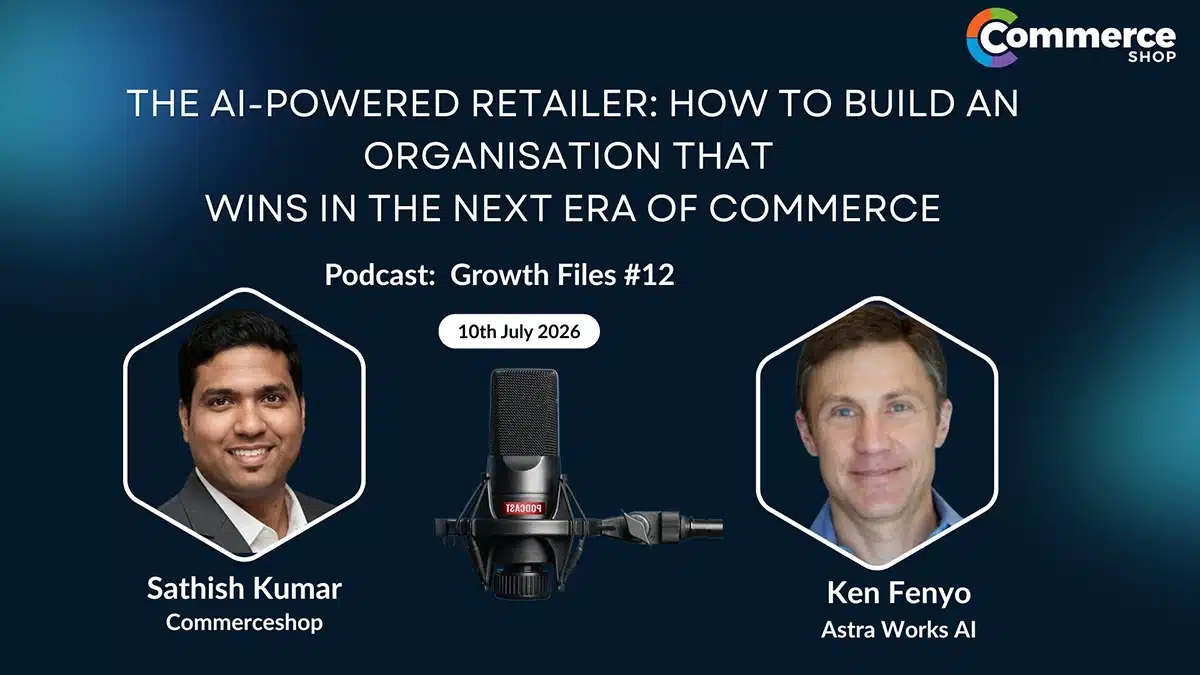
In Episode 12 of Growth Files, Sathish Kumar speaks with Ken Fenyo, a retail executive with close to 30 years across loyalty, customer data and technology, about why AI programs stall at the organizational layer, what a quarter of shoppers already do beyond a retailer’s line of sight, and where the value sits once the pilots end.
Episode TL;DR
- •AI is the biggest opportunity in retail right now, and where the most retailers are stuck.
- •Loyalty gets sharper with AI and more exposed at once, because shoppers can finally price a point.
- •AI does not clean up bad data. Fragmented data is what makes models hallucinate.
- •Wegmans, at roughly 100 stores, scored level with Kroger and Albertsons across 25 grocers studied on agentic commerce readiness.
- •A quarter to a third of shoppers use AI during discovery, creating dark search.
- •At Kroger, replacing one lost loyal customer took roughly nine new ones.
In This Conversation
- The Biggest Opportunity in Retail Sits Where Everyone Is Stuck
- Loyalty and AI: A Genuine Double-Edged Sword
- Where Retail AI Creates Value Today
- The Data Misconception That Costs the Most
- Why Willingness Beats Size in Retail AI Readiness
- Random Acts of AI and the Change Management Problem
- Dark Search: What AI Discovery Takes Away
- Intent Data, Trust, and Why the Website Still Matters
- What AI Can See on the Store Floor
- Generative Engine Optimization Is a Question Problem
- Where to Start, and Who Owns AI
- AI Culture and What Actually Happens to Jobs
About the Guest and Host

Ken Fenyo, Co-Founder of Astra Works AI and Managing Partner at Pine Street Advisors. Close to 30 years in retail and technology, including VP of Loyalty and Digital at The Kroger Co., CEO of YOU Technology, CMO at Grabango, President of Research and Advisory at Coresight Research, and senior consultant at McKinsey. He hosts The Retail Playbook.

Sathish Kumar Mariappan, CEO and Co-Founder of CommerceShop and host of Growth Files. Sathish leads a revenue-first eCommerce consultancy for brands scaling from $2M to $25M, focused on conversion optimization, answer engine optimization and B2B manufacturing commerce.
The Biggest Opportunity in Retail Sits Where Everyone Is Stuck
Two forces are hitting retail at once, pulling in opposite directions.
Ken: “There have been a lot of changes in retail, and AI is definitely a huge one. There are broader consumer shifts too: affluent consumers spending more, and a lot of people strapped. But from a tech point, AI has the most opportunity, and it’s where most retailers are struggling.”
A bifurcated customer base compresses margin at one end and raises expectations at the other, which is when operating leverage matters most. That puts AI at the top of the opportunity list and the stuck list at once.
Loyalty and AI: A Genuine Double-Edged Sword
Ken ran loyalty and customer data at Kroger, which makes him well placed on whether AI makes retention easier or harder. His answer is both. Personalization gets considerably sharper.
Ken: “Kroger took its customer data and delivered very personalized coupons. If you bought Tide, you got a Tide offer. It drove behavior, but it was limited, and we often used spreadsheets to work out which household got which offer. With AI you personalize the channel, the content, the images, not just the offer.”
The downside arrives from the customer’s side of the transaction.
Ken: “The challenge is that loyalty works partly on the gap between the perceived and actual value of a point. Take fuel rewards. Spend $100, get 10 cents off your fuel. On a 15-gallon tank that’s about $1.50, roughly one and a half percent. People feel it’s worth more, because they hate paying for gas.”
Ken: “If the AI engines make clear a point is worth a penny, that changes the program.”
Nobody standing at a pump runs that arithmetic, and an assistant returns it in four seconds. Retail loyalty economics have leaned on that gap for decades. Programs built on mechanics that survive scrutiny hold up. Programs built on the feeling of a reward face a harder few years.
Where Retail AI Creates Value Today
Plenty of retailers run AI across many areas with little to show for it. Ken names two use cases that consistently work.
1) Conversational access to your own data.
Ken: “Right now the real value is being able to interrogate your data better. You’re analyzing the week’s sales and someone asks, why did sales go up in this market and down in that one? Historically you’d pull data, quality check it, do all this work. Teams now find those answers in real time.”
2) Synthesis for the frontline.
Ken: “At store level, managers get 40 to 100 emails a day. AI cuts that to the three to five things that matter today.”
Sathish asks where the enterprise Copilot and Gemini rollouts sit, since many retailers treat them as the finish line.
Ken: “It’s an easy first step to get your feet wet. The higher value use cases are spatial intelligence in the store, or demand forecasting for perishables. Those will take hold, but a lot of organizations start with the comfortable option.”
Both working use cases share a trait: they shorten the distance between a question and an answer, and leave the decision with a human. Both produce a number a CFO will fund a second phase against. A roadmap that stops at the first row of that table has bought software and called it capability.
The Data Misconception That Costs the Most
One misconception outranks the rest, and it is expensive.
Ken: “The biggest one goes back to data: the idea that AI will fix your data problems. The thinking is, I’ve got all this messy data, still siloed after 20 years of trying, I’ll put an AI engine on it and it works magically. It makes things worse, because AI hallucinates when the underlying data isn’t well connected.”
Ken: “You have to integrate it and add context or semantic layers on top.”
Sathish names the pattern: skip data modernization, jump straight to implementation.
Ken: “Exactly. In fairness, a lot of organizations are doing the hard work now of integrating their data. But I don’t think they realize the extent of the work involved.”
Retail data is unusually fragmented. Point of sale, loyalty, e-commerce, supply chain and store operations each hold a partial view of the same shopper, often keyed differently. A model sitting on top fills the gaps with something plausible. A semantic layer, a written definition of what every field holds and how entities relate, makes a warehouse legible to a model. Skip it and the output arrives confident and wrong, which costs more than silence because somebody acts on it.
Watch the Full Episode on YouTube
The video version runs the whole conversation, including the agentic commerce study behind the Wegmans finding.
Why Willingness Beats Size in Retail AI Readiness
Ken’s firm focuses on the mid-market, and he is precise about where the pain sits.
Ken: “Our focus is the mid-market, chains from 100 stores up to a couple thousand. A Kroger or a Walmart already has huge teams on AI strategy plus relationships with the McKinseys and BCGs of the world. The ones really struggling are large enough to know they need it, and large enough that it’s hard to do.”
Then comes the finding that reframes how a regional chain should read its position.
Ken: “We did a study recently on agentic commerce across 25 top grocers. Most had barely started. But Wegmans, around 100-ish stores, scored essentially the same as Albertsons and Kroger. Kroger’s a $100 billion-plus company, and Albertsons is roughly 10 times the size of Wegmans.”
Ken: “It’s not size, it’s willingness.”
Capital turns out to be the wrong variable. Coordination cost is the binding constraint. A 100-store operator with an engaged leadership team pushes a change across the estate in a quarter, where a 2,500-store chain spends most of a year on it. Scale buys consulting relationships and headcount, along with committees, legacy systems and sequencing dependencies.
Random Acts of AI and the Change Management Problem
Retail leaders have run this play before. Against the digital transformation wave of 10 to 15 years ago, Ken sees mostly similarity, with one exception.
Ken: “Before the heavy digital transformation there was a transformation around using customer data better, and I lived through that one at Kroger. The difference with AI is that it’s moving much faster, so you can’t wait for it to get comfortable. But change management was the hardest part of every wave, and it still is.”
Which brings him to the phrase that names the state of most retail AI programs.
Ken: “Most organizations right now are doing what we call random acts of AI. A group over here is doing something, maybe they licensed technology, or frankly they’re using their personal ChatGPT or Claude account.”
Ken: “Most want lower-hanging fruit, usually Microsoft or Google, because they already use them for email. Getting going beats planning for a year.”
Four questions separate a strategy from a pile of activity:
- What business outcome are we buying, stated as a number?
- Which use cases matter most given where we are weakest today?
- What guardrails apply, and who enforces them?
- What budget is committed, and which single executive owns the result?
The test has little to do with how many pilots are running. Ask two leaders those four questions and see whether the answers match. Bottoms-up experimentation builds real literacy and stops short of compounding: two teams solving the same problem in two tools produce two vendor dependencies and one shared lesson.
Dark Search: What AI Discovery Takes Away
A quarter to a third of shoppers already run discovery through an assistant. Ken treats that as a live threat with two edges.
Ken: “A pretty strong quarter to a third of customers already use AI in discovery. They go to ChatGPT and type, I’m looking for a new swimsuit, I’m going on vacation, what do you recommend? If people start buying directly from the LLMs, that’s real disintermediation risk.”
The second edge is quieter and arrives sooner.
Ken: “But even before that, if they buy the swimsuit on your site, all you know is that they bought a swimsuit. None of the background. People call that dark search.”
| Discovery path | What the retailer records | What stays invisible |
|---|---|---|
| Traditional site search | Query, clicks, purchase | Occasion, constraints, rejected options |
| ChatGPT first, retailer second | A purchase, a referral source at best | The consideration set and the reasoning |
| Conversational search on your site | Occasion, constraints, budget, alternatives | Very little |
His response splits into two parallel moves.
Ken: “Invest in product data, and get the word out on Reddit, social media, Wikipedia, the places that feed the LLMs. And do more on their own sites. Consumers will expect a search bar to mean a real conversation, not typing swimsuits and sorting through it themselves.”
Sathish raises Amazon’s Rufus, which sits beside the search experience as its own destination. Ken’s study found the same pattern across the category.
Ken: “Amazon, Walmart and Albertsons were adding interesting experiences to their own sites, and grocery is oddly one of the categories investing more heavily. But out of 25 leading grocers, nobody had put AI into the search bar. Everything was a side experience.”
Losing a transaction is the loud version of this problem. Losing the reasoning behind it is the expensive one. Every AI-assisted journey elsewhere hands a retailer a SKU and a timestamp, which quietly degrades assortment planning, personalization and demand forecasting. Zero out of 25 grocers having built conversational search reads as an open lane.
Listen to the Full Conversation on Spotify
The audio version runs the full 54 minutes, including guardrails for AI agents and where in-store technology goes next.
Intent Data, Trust, and Why the Website Still Matters
If an assistant handles discovery, pricing and checkout, why visit a retailer’s site at all? Ken sits with the uncertainty before answering.
Ken: “It’s a good question, and I don’t know. But there’s a trust factor. From research I’ve seen, people still trust the retailer more than the third-party LLMs. And if I have a long history with you as a customer, I should be able to be more personalized than some random LLM.”
Behavior also moves slower than technology.
Ken: “Humans are creatures of habit. We underestimate how long it takes people to change what they do. Grocery e-commerce has existed in some form for 20 years and it’s still only creeping toward 20 percent of total sales.”
The prize is the intent currently flowing to somebody else.
Ken: “We get what you bought, and online we get clickstream. What we don’t get is why. In a conversation with an assistant, someone says my dog is getting older, he’s put on weight, I’d prefer organic and ideally grain-free. That’s an incredibly rich picture, and right now it goes somewhere else.”
Ken: “The onus is on retailers to build experiences where customers share that and it gets used.”
On segmentation, Ken expects enrichment, since merchandising strategy and vendor-funded campaigns both work at the level of groups.
Ken: “I can’t have a merchandising strategy for every individual customer, and neither can a CPG running a campaign. AI enriches segmentation.”
The dog food example works as a stress test. If a customer told you their dog was older, overweight and needed grain-free food, could your systems act on that across email, site and store this week? For most retailers the honest answer is no. Habit buys runway, and the 20-year grocery curve says roughly how much, though a decay curve makes a poor defense. Trust compounds with purchase history, and a general assistant has neither.
What AI Can See on the Store Floor
E-commerce leaves a data trail. Stores leave far less, and Ken points to a gap that surprises outsiders.
Ken: “The biggest impact in the store is computer vision, particularly information at the shelf. People outside retail find this hard to believe, but retailers have a really bad idea of what’s on the shelf at any given time. They know what gets sent to the store and what gets sold, not whether the Cheerios shelf is empty.”
Ken: “And out of stocks are a real loyalty issue. If the item I want isn’t there, it reduces the chance I come back.”
On measurement, Ken keeps it commercial.
Ken: “I’d certainly track out of stocks. Reduce them from 10 or 12 percent to five and that’s hundreds of millions of dollars of increased sales industry-wide. But ultimately I look at the store in simpler terms. Are same-store sales going up? Is traffic increasing?”
| Layer | Metric | Question it answers |
|---|---|---|
| Operational, leading | On-shelf availability, out-of-stock rate | Is AI closing the execution gap |
| Operational, leading | Planogram compliance | Does the store match the plan |
| People, leading | Associate turnover | Are tools removing workload or adding it |
| Commercial, lagging | Store traffic and same-store sales | Is the investment working |
On-shelf availability makes the strongest opening case for in-store AI. Out-of-stocks sit on top of three problems most retailers manage separately: sales lost today, a loyalty penalty next month, and substitution friction that damages the online basket. Shelf-level computer vision moves all three at once, and the shopper feels it inside a single trip.
Generative Engine Optimization Is a Question Problem
Asked about rising acquisition costs, Ken starts wider than expected, then lands on retention.
Ken: “Oddly, I’d take a pretty broad view. TV, radio, direct mail. Traditional media has been undervalued because of digital and the ability to target. I was at a conference where a retailer talked about increasing their TV buy and driving real incremental sales. You also need visibility on the AI engines.”
Ken: “But I’ve always believed retention matters more. At Kroger we had to acquire nine new customers for every loyal one we lost.”
That nine-to-one figure belongs in every AI budget conversation. A use case that keeps existing customers carries the weight of several that find new ones.
On AI visibility, Ken separates it from the SEO playbook retailers know.
Ken: “It feels a lot different. SEO was something people could get their hands around. There was an algorithm, you could test things. The interesting thing on GEO is the need for better product data. Not just depth, but are you answering the questions people actually have?”
Ken: “If you’re selling bathing suits: is there a key pocket inside? Will it lose color in salt water? How quickly does it dry? Those don’t get answered anywhere.”
| What most product pages cover | What shoppers ask an AI assistant |
|---|---|
| Fabric composition | Is there a key pocket on the inside? |
| Brand and benefit copy | Will the color fade in salt water? |
| Size chart and care instructions | How quickly does it dry? |
One principle carries over from SEO: visibility still has to be earned through content. Almost everything else changes. Generative engine optimization and answer engine optimization work at the level of a question, and the unit of work is something a shopper wants to know that your product page leaves unanswered. That question set lives in your reviews and support tickets, well away from the attribute list a PIM carries.
Advertising Inside Answer Engines
Paid placement inside assistants is arriving slowly, and Ken has data on who has moved.
Ken: “ChatGPT is experimenting most. When we did our study, Amazon was the only major retailer actively advertising on its own answer engine. Kroger, Walmart, Target and others say they’re experimenting, but in small tests.”
Ken: “It’s hard to imagine the LLMs and the retailers don’t eventually see those answers as a channel. The care needed is around trust. People feel ChatGPT is their advocate, so if it looks like you only recommend whoever paid, you undermine the experience.”
When the Model Gets Your Product Wrong
The sharper near-term risk is misrepresentation.
Ken: “I’m already seeing a lot of tools that help you figure out how you’re showing up in the LLMs. Are you showing up at all? Are you positioned the right way? If someone asks whether a product shrinks, and yours doesn’t but the model says don’t buy it because it shrinks, you have to be very proactive.”
Ken: “That’s harder than fixing an error on your own site. If Reddit is feeding ChatGPT and threads there misrepresent your product, you have to go change that.”
Sathish raises the same pattern from CommerceShop’s sister organization, ConversionBox, which works on AI visibility and regularly finds brands described negatively with no factual basis. Ken agrees the work stays manual for now.
Ken: “It’s hard work, and there isn’t an easy answer. In some ways we’ll look back on the easy days of SEO and think, wow, that was manageable. People underestimate how much the engines hallucinate, and that shoppers just accept it. If ChatGPT tells me your product isn’t good, I’ll assume that’s true.”
Shoppers skip the fact check. Until the underlying sources change, a wrong answer works exactly like a true one, which puts AI misrepresentation between a reputation problem and a distribution problem. Most retailers have nobody assigned to it, because it falls between brand, e-commerce and PR. Monitor on a schedule: fix at the source, close the question gap on owned pages, and give any persistent hallucination an owner and a deadline.
Where to Start, and Who Owns AI
For a retailer yet to begin, the sequencing is deliberate and top-down.
Ken: “I’d start with strategy. A lot of organizations are very bottoms-up: marketing did something here, IT is doing coding tools, merchandising something else. Start at the top. What are we trying to get out of AI? Where do we focus? What guardrails? What budget?”
Ken: “There’s also value in a third party with experience, because every week brings a new model or a competitor announcement.”
Guardrails sharpen as automation deepens.
Ken: “The big one is knowing where you let the AI do work and where a human checks it. Even when you’re only using AI to review data, what process makes sure that data is accurate? What keeps confidentiality between groups and with the outside world?”
Ken: “That gets sharper once you automate with agents. What do we allow to be automated, and what checks keep things moving where we want?”
On the Chief AI Officer title now appearing across the industry, Ken cares about accountability over the label.
Ken: “I see it a lot. It’s helpful to have one executive on point, because somebody has to work across functions and push change through. Do they need the title? Probably not. Some of it is signaling. What matters is having somebody on the hook.”
Sequencing is the whole game. A written strategy naming use cases and budget stops random acts from reassembling six months later. Guardrails come next and need specifics: where human review is mandatory, how confidential data moves between teams and vendors, and what an agent may do without approval. Tooling comes last and stays easiest to reverse, which is why so many organizations decide it first.
AI Culture and What Actually Happens to Jobs
Culture decides whether any of this survives contact with the organization.
Ken: “It has to be led from the top. People should see the CEO embrace AI, use it in meetings, talk about it. If the senior people aren’t engaged, the rest won’t follow.”
Ken: “Then rethink your processes, because automating the current process gets you some value, but the real value is rethinking across functions and silos.”
The adoption failure he describes is widely recognizable.
Ken: “What retailers usually do is dump something new on everyone’s desk, so people see it as one more thing to master. The ones that succeed show employees, in stores as well as headquarters, that this takes off work they hate.”
Four conditions separate a program from a pile of pilots, and every one is a leadership behavior: visible executive use, process redesign, coordination across silos, and training framed around work removed. The last one is where most rollouts break.
Asked for advice to a CEO, Ken opens with a joke and lands somewhere useful.
Ken: “Well, you should give me a call, I’d say first. But everyone has good intentions. I’ve yet to meet a CEO who isn’t thinking about AI. The key is starting with what you want out of it, and in retail that comes back to the customer. How do I deliver a better experience, and how do I make my associates’ jobs easier so they can deliver it?”
On jobs, his answer runs against the prevailing instinct, and he knows it.
Ken: “It’s clearly going to change jobs. If I’ve got analysts whose whole job is pulling sales data into a report every Monday, I don’t know that job stays around. In the store, a lot of retailers see a chance to take labor out. That’s a big mistake, and I sometimes lose this argument.”
Ken: “The store experience becomes more important in the AI world, because that’s a place AI doesn’t necessarily touch. Maybe you need fewer cashiers, but I’d repurpose those people toward customer experience.”
Follow the logic and it holds. If agentic commerce disintermediates the online channel first, the physical store ends up least exposed, so cutting store labor pulls capacity out of the channel with the most defensible economics. Analyst roles built on manual reporting genuinely change, and retraining toward higher-value analysis answers that. On the floor, whether roles disappear or get repointed at customer experience remains a decision somebody makes.
What Retail Leaders Should Do Now (Checklist)
Commit to the first three this month. They cost very little and tell you how much of the rest applies.
- ✓Inventory every AI tool in use, including personal accounts, and log who pays for what
- ✓Name the executive who answers for AI results, with or without a new title
- ✓Pull your out-of-stock baseline and size the gap to 5 percent
- ✓Map which systems hold which pieces of the customer record and where identifiers break
- ✓Draft semantic layer definitions for the data your first use case touches
- ✓Pull the top 50 questions from reviews and support tickets in your biggest category, then score your best-selling product pages against them
- ✓Check monthly how the major assistants describe your brand, products and policies
- ✓Scope conversational search for your site and decide what intent you will capture
- ✓Write down where human review is mandatory and what data stays inside the building
Retail AI FAQ
What is an AI-powered retailer?
A retailer organized around AI: a single accountable executive, a written strategy tied to business outcomes, integrated data with a semantic layer, and guardrails defining where humans review AI output.
Will AI fix messy retail data?
No. Fragmented data is why models hallucinate, so adding AI on top amplifies the problem. Integration comes first, followed by a semantic layer that defines what each field means and how entities relate.
Does generative engine optimization replace SEO?
No. SEO earns rankings and clicks. GEO earns citation inside AI answers. Both run in parallel, and GEO depends on product data that answers real shopper questions.
Ready to Work Out Where Your Commerce Business Actually Stands?
Most commerce teams have a sequencing problem: pilots running ahead of strategy, data unready for what sits on top of it, and product content that answers questions nobody asked. CommerceShop works on that gap, from data readiness and conversational search through to answer engine and generative engine visibility.
Book a Call With CommerceShop →Keep the Conversation Going
This is Episode 12 of Growth Files by CommerceShop, where operators and advisors share what works in commerce, brand and AI.

