
Why Most SMB Ecommerce Websites Are Not Ready for AI-Powered Discovery
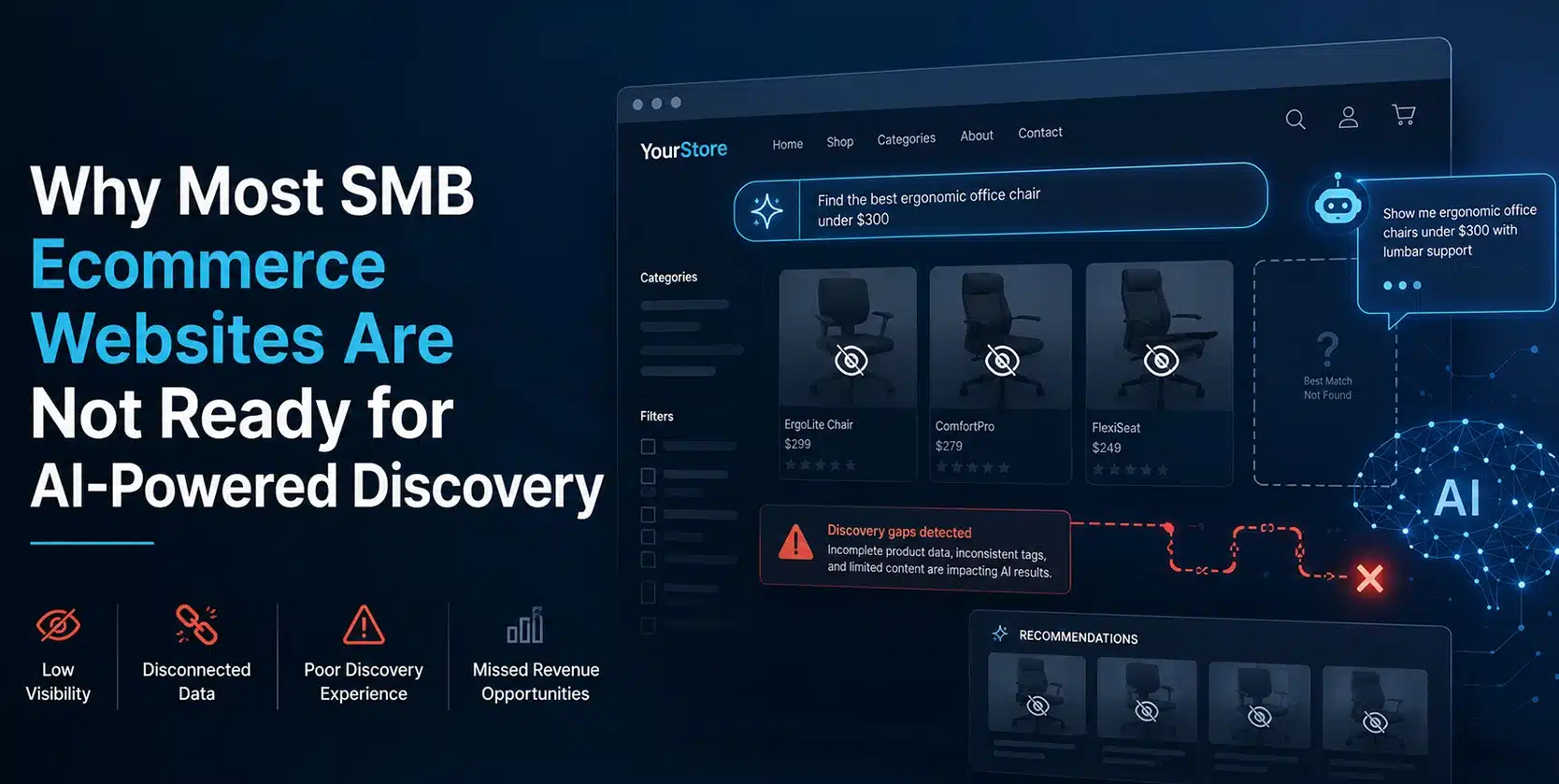
The Shift That’s Quietly Reshaping Ecommerce Discovery
Shoppers are no longer just typing queries into Google. They are asking ChatGPT what to buy. They are using Google Gemini to compare products side by side. They are letting Microsoft Copilot pick gifts and recommend brands. AI-powered discovery is no longer a futuristic concept. It is happening every day, in millions of shopping conversations.
For SMB ecommerce brands, this shift creates an entirely new visibility layer. Search is no longer just about Google ranking your pages. It is also AI tools deciding which products to recommend. And those AI tools need structured data to make that decision.
Most SMB brands have not noticed yet. Their organic traffic is plateauing. Their conversion rates are stalling. They blame Google algorithm changes, rising ad costs, or general market conditions. The real reason may be far simpler, and far more structural, than they realise.
The Quick Summary
- We audited 305 SMB ecommerce brands across Shopify, Shopify Plus, and WooCommerce, and found that less than 1% are fully prepared for AI-powered product discovery.
- AI visibility depends on five key schemas: Product (49.8%), FAQPage (9.2%), Rating (1%), Offer (<1%), and Review (<1%) adoption.
- Most brands have FAQ content, but 99 sites lack FAQPage Schema, making answers unreadable to AI tools.
- Fixes: audit existing schema, add FAQPage Schema, implement Offer Schema, and maintain ongoing schema validation.
What We Audited: 305 SMB Brands Across Three Platforms
To understand how prepared SMB ecommerce brands are for AI-powered search, we conducted a structured data audit of 305 small and medium-sized ecommerce websites across three major platforms: Shopify, Shopify Plus, and WooCommerce.
The audit covered brands operating in the United States and Canada, with annual revenue ranging from $42,000 to $43.3 million, and a combined revenue of $2.2 billion across the dataset. We successfully scanned 301 of 305 sites (98.7%), examining their homepage, product page, and FAQ page for the schema markup that AI shopping tools rely on to understand and recommend products.
What we found should concern every SMB ecommerce brand operating today.
The Headline Finding: Less Than 1% of SMB Brands Are AI-Ready
Less than 1% of the 305 brands we audited have the structured data required for full AI-powered shopping visibility.
Specifically, we found:
- 49.8% have Product Schema implemented
- 9.2% have FAQPage Schema
- 1.0% have Rating Schema
- Less than 1% have Offer Schema
- Less than 1% have Review Schema
These five schema types are the foundation of how AI shopping tools like ChatGPT, Google Gemini, and Microsoft Copilot find, understand, and recommend products. Without them, an ecommerce site is functionally invisible to AI-mediated commerce. Half of our dataset has partial schema. Almost none have what is required to participate fully in AI shopping conversations.
The Five Schemas That Determine AI Visibility
Not all schema is equal. Some types are nice to have. Others determine whether your products can appear in AI-powered shopping recommendations at all. Here are the five that matter most for SMB ecommerce brands.
Product Schema (49.8% adoption)
Product Schema tells AI tools what a product is: its name, image, description, brand, and category. Half of our dataset has implemented this, mostly through default Shopify and Shopify Plus themes that generate it automatically. Without Product Schema, AI tools struggle to identify products at all.
Offer Schema (Less than 1% adoption)
Offer Schema is the make-or-break field for AI commerce. It tells AI tools the live price, currency, availability, and shipping status of a product. When ChatGPT recommends a product, when Gemini surfaces a price comparison, when Copilot generates a buy link, it pulls from Offer Schema. Almost no brand in our 305-brand dataset has this implemented. The exclusion is universal.
FAQPage Schema (9.2% adoption)
FAQPage Schema allows AI tools to read and cite a brand’s FAQ content directly in conversational answers. When a shopper asks “is this product safe for sensitive skin?”, sites with FAQPage Schema get their answers surfaced. Sites without it are skipped entirely, even when they have the exact answer written on their site.
Rating and Review Schema (1% and less than 1%)
Rating Schema and Review Schema power AI-generated “best rated” and “most reviewed” recommendations. If you have customer reviews on your product pages but no Review Schema, your reviews are invisible to AI tools. Only three brands in our entire dataset have Rating Schema. Almost none have Review Schema.
The Universal Zero: The One Field Everyone Is Missing
The most striking finding in our audit was the universal absence of Offer Schema. Across 305 brands, across three platforms, across every revenue tier from $42,000 to $43.3 million, less than 1% had Offer Schema implemented.
This is not a gap. It is a structural exclusion. Offer Schema is the field that AI shopping interfaces use to quote a price, confirm availability, or generate a working purchase link. Without it, no AI tool can recommend a product with confidence. The brand is functionally invisible to AI-mediated shopping, regardless of how good their product is or how much organic traffic their site receives.
If there is one fix to prioritise from this entire research, it is this one. Offer Schema is the single most important addition any SMB ecommerce site can make to participate in AI-powered discovery in 2026.
The Platform Divide: Where You Build Matters More Than You Think
Schema adoption is not evenly distributed across ecommerce platforms. The platform you choose dictates how much schema your site generates by default, and how much manual work you need to do to close the gap.
Shopify Plus: 63% Product Schema Adoption
Shopify Plus leads the dataset on Product Schema adoption at 63%. Most modern Shopify Plus themes generate Product Schema automatically as part of their default template structure. If you are on Shopify Plus, you likely already have basic Product Schema in place. Your focus should be on filling in the gaps: Offer Schema, Review Schema, and FAQPage Schema.
Shopify: 54.6%, Close Behind But With Gaps
Standard Shopify sites sit just below at 54.6% Product Schema adoption. Theme quality varies more on Shopify than on Plus, so verification matters. Open your product page source code and search for “@type”: “Product” to confirm what your theme is actually generating.
WooCommerce: 24%, A Structural Problem
WooCommerce brands fall to just 24% Product Schema adoption, a 39-percentage-point gap behind Shopify Plus. WooCommerce does not generate Product Schema by default. Merchants need to install a dedicated schema plugin like RankMath, Yoast SEO, or Schema Pro, and configure it explicitly. If you are on WooCommerce and have not done this, your site is almost certainly invisible to AI shopping tools.
The FAQ Paradox: 99 Brands Wrote Answers AI Can’t Read
127 brands in our audit have FAQ content on their site. Only 28 have wrapped it in FAQPage Schema. The other 99 have done the expensive work of writing FAQ answers and made them unreadable by every AI search tool currently in use.
This is the most relatable finding for SMB ecommerce brands. Almost every site has an FAQ section. Almost none have the schema markup that turns that content into AI-readable answers. Adding FAQPage Schema does not require new writing. It requires wrapping existing content in JSON-LD markup, a job that takes a developer a few hours.
If you have FAQ content on your site and you have not implemented FAQPage Schema, you are losing AI search visibility every day. This is the single fastest, highest-impact fix available in the entire schema landscape.
Even the Leaders Are Exposed
Schema adoption is not correlated with revenue. Among the 10 highest-revenue brands in our dataset, no brand has scored above 1 out of 5 on our Schema Completeness Score. Three of the top 10, with combined annual revenue of $115 million, scored zero.
These brands have the resources, the technical teams, and the marketing budgets to implement complete schema markup. They have not done it. The gap is not a question of capability. It is a question of awareness and prioritisation.
This means the playing field for AI search visibility is genuinely level right now. SMB brands at $5M, $15M, or $30M in revenue have the same opportunity to close the gap as a $43M brand. The brands that move first will own the AI search channel before larger competitors catch up.
How to Fix It: The 4-Step AI Readiness Roadmap
The fixes are not technically difficult. The hardest part is sequencing them correctly. Here is the order we recommend for AI search readiness, prioritised by impact-to-effort ratio.
Step 1: Audit Your Current Schema
Before you fix anything, know what you have. Use Google’s Rich Results Test (search.google.com/test/rich-results) or Schema.org’s validator (validator.schema.org) on your homepage, your top three product pages, and your FAQ page. Both tools are free. They will show you exactly which schemas are present, which are missing, and which are broken.
Step 2: Add FAQPage Schema (The Fastest Win)
If your site has an FAQ page, wrapping it in FAQPage Schema is the single fastest improvement you can make. Implementation takes 1 to 2 hours of developer time and requires no new content. Impact: your answers become citable by ChatGPT, Gemini, and Perplexity in conversational shopping queries.
Step 3: Implement Offer Schema (The Highest Impact)
Offer Schema is the universal gap. Adding it to every product page is the single most important fix for AI shopping visibility. If you are on Shopify or Shopify Plus, check whether your theme already generates partial Offer Schema and fill in the missing fields. If you are on WooCommerce, plan a structured rollout with a dedicated schema plugin.
Step 4: Make Schema a Continuous Process
Schema is not a one-time fix. New products, new content, new pages all need schema. Brands that reach top decile AI-readiness build schema validation into their development workflow, running automated checks on every site update. This is what separates brands that score 2 today from brands that will score 4 or 5 when their platforms support it.
Request your free AI Readiness Audit
What to Do Next
Less than 1% of SMB ecommerce brands are ready for AI-powered discovery. The window to fix this and gain a competitive advantage in AI search is open, and it will not stay open forever.
If you want to know exactly where your site stands, we are offering free personalised AI Readiness Audits to SMB ecommerce brands. We will analyse your site against the same framework we used for the 305-brand research, identify your specific gaps, and recommend the highest-impact fixes for your platform.
FAQs
1. Why does AI-powered discovery matter for ecommerce brands?
AI shopping tools are increasingly influencing how customers find and compare products online. Brands without structured data may not appear in AI-generated recommendations or shopping answers.
2. Can a website rank on Google but still be invisible to AI tools?
Yes. A site can perform well in traditional search while lacking the schema markup AI systems need to understand pricing, reviews, or FAQs.
3. Why are FAQ pages important for AI search?
AI tools often pull direct answers from FAQ content during conversational searches. Without FAQ Schema, those answers may not be surfaced even if the content exists.

