
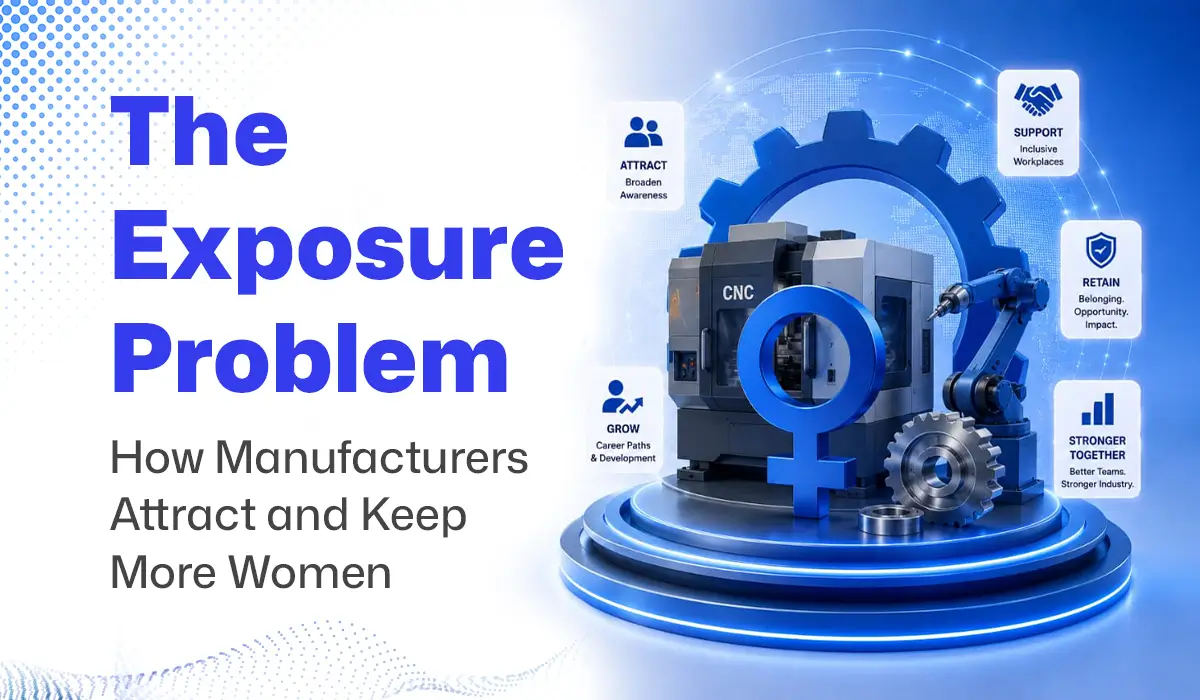
The Exposure Problem: How Manufacturers Attract and Keep More Women (Growth Files Ep. 19)
Walk a trade show floor twenty years ago and you would find plenty of women in the booths. Almost none were there to talk about the products. They were hired to draw a crowd, and the industry had a name for them that has since fallen out of public use.
Meaghan Ziemba counted the women engineers she met in those years on one hand.
In Episode 19 of Growth Files, Sathish Kumar speaks with Meaghan Ziemba, host of Mavens of Manufacturing and owner of Z-Ink Solutions, about what has changed since, what has stubbornly refused to, and why the American manufacturing labor problem may have been diagnosed wrong from the start.
Episode TL;DR
- Women hold roughly 29 to 30 percent of US manufacturing jobs, against about 47 percent of the total American workforce.
- Only one in three manufacturing professionals and one in four manufacturing leaders are women.
- The pay gap inside manufacturing runs about 15 to 17 percent.
- The broken rung: for every hundred men promoted, 93 women are promoted. It compounds annually.
- 63 percent of women name workplace flexibility as their biggest obstacle, against under 40 percent of men.
- Meaghan’s core argument: this is an exposure problem, and the talent already exists.
- Career pathway conversations start in sixth grade. They should start in elementary school.
- Two interns chose a company because it was the only career-day table with a woman at it.
- Stop running women in manufacturing as a campaign and make it ordinary instead.
About the Guests
Guest

Meaghan Ziemba, founder and host of Mavens of Manufacturing and owner of Z-Ink Solutions, LLC. A technical writer with a BA and MA in Professional and Technical Writing from the University of Wisconsin-Milwaukee, Meaghan has been writing for industrial manufacturing since 2008 and works as a journalist with MTD/CNC. She launched Mavens of Manufacturing in 2020 to give women in the sector a platform, and mentors a FIRST Robotics team. LinkedIn · mavensofmanufacturing.com
Host

Sathish Kumar Mariappan, CEO and Co-Founder of CommerceShop and host of Growth Files. Sathish leads a revenue-first eCommerce consultancy for brands scaling from $2M to $25M, focused on conversion optimization, answer engine optimization and B2B manufacturing commerce. LinkedIn
How a Technical Writer Ended Up in Manufacturing
Nobody pointed Meaghan toward this industry. Her path into it was accidental, and the accident is instructive.
Meaghan: “It was not something that I was ever encouraged to pursue. In high school I was always encouraged to pursue writing or marketing or English because my testing was phenomenal in those subjects. Math and science, not so much.”
In college she found technical writing, chosen after a classmate explained that those job opportunities carried more monetary growth than the other English tracks. Both were single mothers, so the reasoning landed. Her first job was at a trade publication called Product Design and Development, interviewing engineers at manufacturers.
The process of designing and creating a product fascinated her immediately, and one point outsiders rarely consider: most of us take for granted the work behind the objects we use every day. Then the line that frames everything after it.
Meaghan: “I didn’t know that any of those positions existed because they were never promoted to me. I was never encouraged to pursue engineering or manufacturing.”
One attempt to leave the industry ended in boredom. Brand storytelling, content strategy and trade show work followed, then Z-Ink Solutions when she wanted more time at home with her children. COVID produced Mavens of Manufacturing in 2020, after the storytelling flooding LinkedIn turned out to come almost entirely from men.
The origin story makes the case for her thesis better than any statistic. Someone with the aptitude and the interest spent an entire education without encountering the option, and found it by chance in a first job. Multiply that by a generation and the labor problem stops looking like scarcity.
What the Numbers Show About Women in Manufacturing
The data arrived prepared, and the figures hold up against their sources.
Meaghan: “Women hold roughly 29 to 30 percent of the US manufacturing workforce, according to a census that FabTech did. That’s compared to about 47 percent of the total American workforce.”
Bureau of Labor Statistics data puts women’s manufacturing employment at 3.6 million as of March 2026, against total employment approaching 12.6 million seasonally adjusted. A benchmark survey from the Women in Manufacturing Association sharpens the leadership picture.
Meaghan: “Only one in three manufacturing professionals and one in four manufacturing leaders are women.”
| Measure | Figure | Source |
|---|---|---|
| Women in US manufacturing workforce | 29 to 30 percent | FABTECH census |
| Women in total US workforce | About 47 percent | FABTECH census |
| Women in manufacturing employment | 3.6 million of 12.6 million | Bureau of Labor Statistics, March 2026 |
| Women among manufacturing professionals | One in three | Women in Manufacturing survey |
| Women among manufacturing leaders | One in four | Women in Manufacturing survey |
| Women in engineering roles globally | 15 to 16 percent | Industry data |
Sentiment reads more optimistic than the raw numbers suggest. In the same survey, 62 percent of female respondents agreed women have made significant progress over the last five years, with optimism about the future reading positive across both genders.
The women she speaks to see the progress and want it moving faster. Engineering remains the sharpest gap of all, at 15 to 16 percent globally. Representation in the general workforce has moved. Representation in the technical and leadership tiers has moved considerably less, which means aggregate percentages mask where the bottleneck actually is.
What Changes When Women Reach the Table
Asked what perspective women bring into the room, Meaghan is careful to avoid diminishing anyone.
Meaghan: “I think in terms of bringing groups together, women have a better skill set. I feel like we’re more emotionally intelligent. I don’t wanna dumb down men, but I think we have a better skill set to bring people together in a collaborative group.”
The pattern she hears repeatedly from women who have climbed concerns who helped them.
Meaghan: “A lot of them share the importance of mentorship. They have expressed, I would not be here today if I did not have that support. Sponsorship and mentorship are massively important when it comes to women climbing the ladder in promotions, leadership opportunities and training.”
Then a detail from a friend that explains a whole category of exclusion. Women were originally left out of company golf outings, and those outings were where the substantive business talk happened.
The fix is a process change, and an invitation policy would fall short of it.
Meaghan: “You should absolutely have stay interviews. Every month you have a conversation about, okay, what are your goals? What sort of positions do you want to pursue? What are your interests? What are your passions?”
The stay interview is the transferable idea here, and it takes a manager an hour. An exit interview collects information after the decision is made, useful for reporting and useless for retention. A monthly check-in about goals catches the same information while somebody can still act on it, and it formalizes what used to happen on the golf course so access depends on employment alone.
The Exposure Problem: Reframing the Talent Shortage
Asked whether US manufacturing faces a talent shortage, Meaghan pushes back on the premise.
Meaghan: “No, I think that’s a big misconception that there’s a talent shortage. I think it’s an exposure problem. There’s talent all over the place. It’s how we are talking about the opportunities and the stories that we’re sharing.”
The diagnosis has three parts.
1) The message misses what younger workers care about. Purpose drives this generation, and equipment specifications land somewhere else entirely. The counter-question she poses: what are those machines and technologies doing to make our lives easier? Do they help with sustainability? Are they environmentally safe? What is the why behind the products being made?
One national frame rarely gets used by manufacturers on themselves: a weak manufacturing base undermines both national security and economic stability.
2) Recruiting starts far too late. Career pathway conversations in the US typically begin in sixth grade.
Meaghan: “How do we start exposing kids to some of these pathways when they’re in elementary school, so that we’re nurturing that curiosity all the way up until they’re in high school and they make a decision?”
3) The descriptions themselves fail. The example comes from a visit to her former high school, to a CNC machining class.
Meaghan: “One of the kids was like, I thought I was signing up for additive manufacturing. I thought it was going to be 3D printing parts.”
A student sat in the wrong class because the description failed to convey what the course was. That is a copywriting failure with a workforce consequence, repeated across job postings, career fair booths and plant tour scripts.
4) Parents form the fourth piece, framed as a target audience worth reaching.
Meaghan: “I think parents have a misconception that some of these jobs are not fulfilling. They think they’re still dirty, dark, dull, and dangerous, which yes, some of them are. We can’t escape that because we’re working with raw materials. But we need to educate parents as to what a maintenance technician looks like, what a robotics programmer looks like, what a PLC person looks like.”
The reach of that gap surprises people. Plenty of American communities have excellent manufacturing facilities in their own backyards and no awareness of them, because the facilities keep quiet.
Reframing a shortage as an exposure problem changes the response. A shortage points at wages and training budgets. An exposure problem points at communication, at the age you start, and at whether your community knows what happens inside your plant.
Storytelling: From Welder to Mars Rover
Sathish asks whether robotics and advanced technology will draw young people in. The answer allows for it and stops short of making it the whole story.
Plenty of kids like working with wood, building things by hand, or welding. Not everyone is the same, and the pathway story has to account for that.
What matters more is where the story goes.
Meaghan: “If you’re a welder, this is where your career pathway could lead. You could be welding submarine parts. You could be welding joints together for a robot that’s going to be launched in space to explore Mars’s surface.”
Then the failure mode, stated plainly: reduce any of it to “you’re just a welder” or “you’re just a machinist” and the excitement disappears. Connecting the dots is the work. Hands-on experience closes the loop.
A rotating apprenticeship model from her community works this way: a stretch at a manufacturer with automation, then construction and building by hand, then a front office role. Participants discover for themselves whether they want to work with their hands, sit at a desk, or be outside.
Any employer running a single-placement internship should look hard at the rotating structure. A young person who has seen little of the industry has no basis for choosing a specialization, and rotation converts a guess into an informed decision. It also protects you from losing someone who liked the industry and disliked their one assigned seat.
The Four Barriers Holding Women Back
The answer on barriers is the most data-dense stretch of the conversation, and it refuses to reduce to a single cause.
Meaghan: “I don’t think the barriers have shifted as much as people want to think.”
| Barrier | The Figure | What It Means |
|---|---|---|
| Pay | 15 to 17 percent gap | Same industry, notably less money |
| Leadership | About a quarter of roles, C-suite frozen near 29 percent | The ceiling has held for years |
| The broken rung | 93 women promoted per 100 men | Small annually, compounding over a career |
| Flexibility | 63 percent of women name it as biggest obstacle | Caregiving load falls unevenly |
| Culture | AAUW research documents higher departure rates | Women leave manufacturing at higher rates than men |
On pay, the gap runs about 15 to 17 percent according to the Manufacturing Institute, the workforce research arm connected to the National Association of Manufacturers.
The broken rung hides in plain sight, and that is what makes it dangerous.
Meaghan: “For every hundred men who get promoted, only 93 women get promoted. It sounds small, but it compounds every single year.”
Seven percentage points reads as noise in one promotion cycle. Compound it across a career and the pipeline thins at every level, which explains a leadership number that holds still while entry-level representation climbs.
On flexibility, women and men name different primary obstacles.
Meaghan: “In one industry survey, 63 percent of women name lack of workplace flexibility as their biggest obstacle compared to under 40 percent of men. Men were more likely to point to pay and advancement.”
Culture is the fourth, documented by the American Association of University Women, a national nonprofit that has researched gender equity since the 1880s. Their study, Factory Flaw, found women leave manufacturing jobs at higher rates than men and higher rates than women in other industries, and ties that back to a long history of harassment and unequal opportunity.
Meaghan: “It’s not really one barrier. It’s pay, promotion, flexibility and culture all sort of reinforcing one another.”
That reinforcement defeats single-lever interventions. A flexibility policy inside a culture that tolerates harassment achieves little, and a mentorship program alongside a 15 percent pay gap sends a mixed message employees read accurately.
Building a Real Path to Leadership
Asked whether companies should build formal advancement programs, the answer starts with what she lacked herself.
Starting her own business exposed the gap: no grounding in the financial information the role required, in an industry where finance runs deep.
The structural recommendation that follows applies well beyond women.
Meaghan: “If a woman wants to get to top leadership, they need to know all aspects of how a business works. What happens on the shop floor, what goes on in shipping and procurement, what’s going on in quality. If companies can develop a program where their leadership is spending time at each level in their business, that’s going to make them better leaders overall. You can’t really know how to lead a company if you don’t know the process in and out of the business.”
For companies with nowhere to start, the infrastructure exists. Women in Manufacturing runs leadership and management programs, SME and other bodies connect leaders across companies, and LinkedIn carries relevant courses. The practical addition is the part that costs money.
Meaghan: “Offering tuition for it too and paying for it would be a big step forward.”
A rotation program answers what mentorship alone leaves open. Mentorship supplies encouragement and advice. Structured time across shop floor, procurement, quality and finance builds the operating knowledge that makes someone credible in a leadership seat. Offer the first alone and you produce well-supported candidates who still lack the business fluency the role requires.
What Companies That Retain Women Do Differently
Sathish asks whether success requires women already in leadership. Meaghan’s answer separates the outcome from the mechanism.
Meaghan: “What they do differently is they have open conversations and they provide a space for women to be candid. It’s communication and transparency and support and mentorship, even sponsorship. It’s giving them room to pursue learning opportunities outside their business.”
Women-owned companies tend to do this better, for the straightforward reason that the leadership went through the same obstacles and knows what helped. The principle extends to everyone.
None of it applies to women alone. The same question works in reverse: how do you help men leaders grow, and does what works for them get applied to women?
Then the assumption that quietly loses companies their best candidates.
Meaghan: “There’s this assumption that especially for women who might be moms, they might not have the time or the ambition to split between being a leader in manufacturing and engineering with some of the duties that they have at home. And that’s just not the case.”
Assumed ambition is the hardest bias to catch, because the decision happens before anybody speaks. A manager who quietly skips someone for a stretch assignment leaves no trace, and the employee experiences it as being passed over with no explanation. A monthly check-in on goals is the counterweight: ask what somebody wants and the guesswork disappears.
Why Representation Changes Who Applies
The clearest illustration of representation comes from a trade show, worth reading closely by anyone who staffs a career fair booth.
A friend, a marketing director for a systems integrator, introduced Meaghan to two new interns. She asked what had drawn them to that company.
Meaghan: “They said during our career day, they were the only table that had a woman representative. We felt that because she was there, she was present, we would have a safe space to go talk to someone in case we needed to have a conversation about anything.”
One person at one table changed where two people applied. The second story explains why that mattered.
Meaghan: “Students in engineering classes didn’t feel like they could raise their hand in a class that was mostly guys because they didn’t want to come across as less intelligent, or the individual holding up the learning process. So they would keep their hand down. They also felt that if I’m a woman raising my hand to ask my male professor a question, I might get judged differently than if it were a male classmate asking.”
Having someone to check that instinct against is the function mentorship performs. Another woman saying “that’s valid” or “you’re overthinking it” resolves the question in a sentence.
On choosing a mentor, the advice is unsentimental: find someone with a skill you want and ask them for it. And the definition of who qualifies remains deliberately open.
Meaghan: “Don’t just look for women mentors, also look for men mentors because they offer a lot of skill sets as well. I’m not trying to wash out men in this industry. I’m just trying to get more women into it.”
AI, Automation and Where Women Fit
On whether AI and physical automation make manufacturing more attractive, the point lands on the industry’s self-presentation.
Meaghan: “There’s a lot of creativity involved in terms of robotics and AI and technology as a whole, just engineering as a whole. I think we’ve kind of masked that where we just focus on it being so technical that there’s no room for creativity. And that’s completely false.”
For anyone who enjoys solving problems and taking on challenges, AI sets them up to succeed here.
On job displacement the position is measured: automation and robotics will absorb some roles, and the framing of total replacement deserves retiring.
Meaghan: “It’s going to leave room for us to create other types of positions where more critical thinking and problem solving are involved. So we are able to be more creative.”
Physical strength becomes less of a gatekeeper as cobots handle the heavy lifting, already visible on floors today. And the skill that rises in value is fundamental understanding.
Meaghan: “We need a better understanding of the basics and the foundation of things. So that if AI can’t figure it out or automation messes up, we have to think, okay, why is it messing up and where is that error coming from?”
Two consequences follow for anyone recruiting. Automating the physical demands removes an entry barrier and widens the addressable talent pool at no cost. And the creativity point is a positioning problem: the work already contains it and the marketing has hidden it.
Schools Cannot Do This Alone
Schools carry real responsibility here and cannot carry it alone. Fifty states, each with distinct rules, regulations and policies, makes a national fix unlikely.
Meaghan: “The manufacturers producing major things in their communities have to connect with the students, the teachers, and the parents. Open up your facilities, have community events, get involved in other community events. Do you have a farmer’s market? Go to the farmers market, talk about what you’re making.”
Manufacturing makes the local economic case better than most industries. Every dollar of output generates additional activity across other local businesses, which makes a plant a foundation as well as an employer.
The teacher problem is the one most manufacturers overlook entirely, and the example is striking.
Meaghan: “The high school I graduated from, one of the CNC teachers actually came out of retirement five times because the new teachers they were bringing in never worked with CNC machines before.”
The most recent hire came from carpentry with lathe and mill experience and no CNC background. The school sent him for additional schooling while the retired teacher mentored him, and he now runs the CNC program.
Meaghan: “If you’re not upskilling the teachers, they’re not going to get very far with the students.”
Where school boards and funding politics block direct involvement, everything adjacent remains possible: fundraising, donations, sponsoring FIRST Robotics teams. She mentors one and secured sponsorship to bring them to IMTS.
Meaghan: “Before, they didn’t know that robots and cobots got as big as they could get. They didn’t realize how big CNC machines could get. One student took a picture of one of the grippers that he saw at one of the booths, applied that design concept to their robot, and they were able to get further along in the competition because of it, and they also got an innovation award.”
That gripper compresses the whole case into one anecdote. A student saw a component at a trade show, understood the principle, applied it to his own build, and won an award. All of it depended on somebody paying for a bus.
Reshoring Needs the Other Half of the Population
With reshoring on the national agenda and roughly 12.6 million people in US manufacturing today, Sathish asks whether the current workforce can meet the demand. The answer is realistic about the ceiling and clear about the opportunity.
Full reshoring stays out of reach, because small and mid-size manufacturers face US costs they cannot absorb. What looks recoverable includes textile manufacturing, semiconductor production, and more robotics and automation work.
Meaghan: “If we’re only looking at half of the population, we’re limiting ourselves on what we can do. Bringing more diversity into these processes brings a more diverse set of experiences, thought processes and idea generation.”
A wider set of thought processes solves more problems, which is what drives innovation. Keep the inputs identical and competitiveness against other countries and companies suffers. The arithmetic is the argument that needs no ideology behind it. A reshoring push requires bodies and skills that a workforce drawing predominantly from half the population cannot supply. Widening the pool is the lever available, and it carries a competitiveness case alongside the fairness one.
Three Things a CEO Should Change
Asked for three concrete changes, the first is the one most likely to make marketing teams uncomfortable.
Meaghan: “They need to stop making women in manufacturing a campaign thing. Right now it’s kind of a marketing thing, and it should just be known that hey, we have these opportunities available, and women should feel comfortable enough to apply.”
1) Communicate the opportunities as ordinary. A campaign signals that something unusual is happening. Routine communication signals that the roles are open and the application is expected.
2) Take accountability for the culture. This is the most direct passage in the episode.
Meaghan: “Are you supporting or ignoring certain toxic behavior? One thing that a lot of women are still experiencing is harassment. You need to be able to confront that behavior and put a stop to it right away, not shove it under the rug.”
3) Live the values on the wall. Posting values on a facility wall counts for little against living by them.
On ten years out, the answer opens with a joke about wanting more women than men on competitive grounds, then lands somewhere quieter. The list: career exposure moved into elementary school, more women business owners and CEOs, and a specific kind of obsolescence for herself.
Meaghan: “Eventually I wouldn’t want to be around as Mavens of Manufacturing because it wouldn’t be needed. As much as I love doing what I’m doing, I would hope that I wouldn’t need to have the conversations anymore to bring more women in.”
A success metric defined as the platform becoming unnecessary is a useful benchmark for any diversity program. The goal is ordinariness, and the campaign ends when its subject outgrows the need for advocacy.
Your Workforce Inclusion Checklist
Start with the first three. They cost a month and expose most of what needs fixing.
- Run your pay bands by gender within the same role and level, and write down the gap
- Count promotions by gender over the last three years against the 93-per-100 benchmark
- Replace one exit interview cycle with monthly stay interviews about goals and interests
- Read your job postings and course descriptions aloud, and check whether a sixteen-year-old would know what the role does
- Audit who staffs your career fair table and plant tours, and who a visiting student would see
- Build a rotation that moves emerging leaders through shop floor, procurement, quality and finance
- Fund tuition for one external leadership program through WiM, SME or an equivalent body
- Book one community-facing appearance this quarter with no recruiting attached
- Ask your local school whether its technical teachers need upskilling, and offer to help
- Name every value on your wall and find the evidence you acted on it in the last year
Women in Manufacturing FAQ
What percentage of manufacturing workers are women? Women hold roughly 29 to 30 percent of US manufacturing jobs, against about 47 percent of the total American workforce. Bureau of Labor Statistics data places women’s manufacturing employment at 3.6 million out of nearly 12.6 million as of early 2026.
What is the broken rung in manufacturing? A promotion pattern in which 93 women advance for every 100 men. The annual difference looks minor and compounds across a career, thinning the pipeline at each level and holding leadership representation near a quarter even as entry-level numbers rise.
Does manufacturing have a talent shortage or an exposure problem? Meaghan Ziemba argues the talent exists and the exposure fails it. Career pathway conversations begin around sixth grade, course and job descriptions rarely convey the actual work, and parents often hold outdated assumptions about conditions and pay.
What do companies that retain women do differently? They hold open, candid conversations, offer mentorship and sponsorship, fund external learning, and confront harassment head on. Structured rotation through shop floor, procurement, quality and finance builds the operating knowledge leadership roles require.
Keep the Conversation Going
This is Episode 19 of Growth Files by CommerceShop, where operators and advocates share what works in manufacturing, commerce and AI.
Subscribe to Growth Files
Get insights from experts on how B2B buyers actually discover, evaluate, and decide in an AI-first world.

