
From K to C: What Wall Street Sees in Retail That the Headlines Miss (Growth Files Ep. 17)
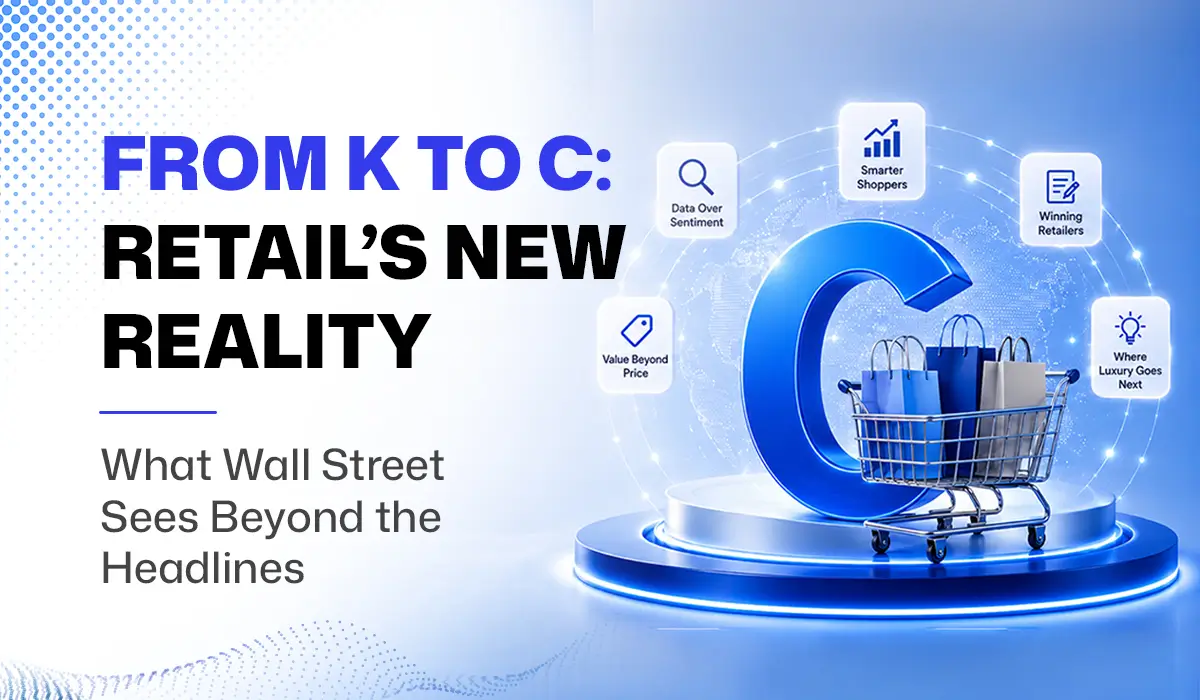
Read the retail headlines and you get a consumer in retreat. Sentiment surveys read low, rates stay high, and every quarter brings another warning about the squeezed shopper.
Then look at what people do with their money and a different picture shows up. Marie Driscoll has spent three decades doing exactly that, and her summary is short: the consumer is resilient, choiceful, and still shopping.
In Episode 17 of Growth Files, Sathish Kumar speaks with Marie Driscoll, CFA, founder of Driscoll Advisors and a three-time Wall Street Journal “Best on the Street” analyst, about the shift from a K-shaped to a C-shaped economy, why what consumers say keeps diverging from what they do, what separates the retailers winning now, and where luxury lands after a brutal correction.
Episode TL;DR
- The K-shaped economy is being renamed C-shaped, with lower-income earners rebounding faster in percentage terms than higher-income ones.
- Lower-income hourly earnings rose 5.5 percent year over year in the second quarter.
- Consumer sentiment and consumer behavior are two different datasets. Watch the second.
- Value means price plus quality plus access plus delivery speed plus sustainability.
- Above $50,000 household income, more than half pay full price. Below it, closer to 30 percent.
- Winning retailers know their customer and serve that customer profitably. Both halves count.
- Discounting erodes brand equity and depletes future growth. Order less instead.
- Multi-channel shoppers spend roughly three times what single-channel shoppers spend.
- Luxury prices doubled between 2019 and 2024, opening the consideration set for everyone else.
About the Guests
Guest
Marie Driscoll, CFA, founder of Driscoll Advisors, providing strategy and due diligence to retailers, brands, retail tech firms and the investment community. Previously Managing Director of Luxury and Fashion at Coresight Research and Director of Consumer Discretionary Retail at Standard & Poor’s. Recognized three times in The Wall Street Journal’s “Best on the Street” analyst survey, including a first place ranking in Clothing and Accessories. Adjunct professor at Parsons The New School, FIT and Baruch College CUNY. RETHINK Retail Top Retail Expert and an NRF Voice of Retail. LinkedIn · mariedriscoll.com
Host

Sathish Kumar Mariappan, CEO and Co-Founder of CommerceShop and host of Growth Files. Sathish leads a revenue-first eCommerce consultancy for brands scaling from $2M to $25M, focused on conversion optimization, answer engine optimization and B2B manufacturing commerce. LinkedIn
From K-Shaped to C-Shaped: What the Data Says
Asked for a first take on the state of retail from a Wall Street seat, the answer starts with a vocabulary change that has been working its way through earnings calls.
Marie: “We’ve been talking about a K-shaped economy and I think it’s recently been renamed a C-shaped economy. The lower income consumer is rebounding. Their year over year hourly earnings income was up five and a half percent in the second quarter, growing at a faster pace on a percentage basis than the higher income earners.”
The K described a split: wealthier households pulling away while everyone else absorbed inflation and higher rates. The C describes convergence, with growth broadening downward into the mid-market and value tiers. Inflation is broadly under control, though gas prices stay higher than anyone wants. The behavior underneath is what matters commercially.
Options are effectively infinite, how people shop has changed, and what they care about has changed. The spending continues regardless, from a consumer best described as choiceful.
The framing is contested, and some economists argue the K persists with lower-income gains yet to prove durable. The practical read for a retailer: the value tier and mid-market are seeing renewed spending power, and planning around a permanently squeezed bottom half misallocates inventory.
Why Consumer Sentiment Misleads Retailers
The gap between what surveys report and what registers ring up defines this section, and sentiment is the weaker signal.
Marie: “Consumer sentiment, what consumers say and what consumers do, are two different things.”
Sentiment sits below where anyone would like it, has run volatile since COVID, and the correlation to actual spending broke somewhere along the way.
Marie: “When the going gets tough, the tough go shopping. They haven’t stopped shopping. That’s the bottom line.”
Trade-offs happen at the margin. Vacations get shortened, holiday spending stays protected. And one funding source shows up nowhere in wage data.
Marie: “People went into their homes and into their closets and found things they weren’t using and monetized them. A side hustle selling that bicycle nobody’s riding anymore, a lawn mower that doesn’t work for your needs, or a handbag from three years ago.”
Resale income is spending capacity wage statistics miss. For a brand it cuts two ways: secondhand competes with new units, and it funds purchases household income alone would rule out.
The Indicators Worth Watching
The first indicator is psychological.
Marie: “You haven’t cashed in on your capital gains, but you feel richer. And when you feel richer, you spend money.”
The price level has reset permanently.
The price level has reset permanently. Everyone has absorbed inflation and tariffs since 2023, and while inflation is broadly under control, pre-COVID prices are gone. Consumers have adjusted, and they have gained alternatives at every tier. One brand reset the price of a category staple.
Marie: “You have Quince that gives you a cashmere sweater for a hundred or a hundred and fifty dollars versus two hundred to five hundred to two thousand. There’s just so many choices at the low end.”
Two forces define the trading environment: elevated prices, and credible cheaper options in nearly every category. A brand holding price without a defensible reason gets tested constantly.
Value Has Stopped Meaning Price
The working definition reaches considerably wider than a discount.
Marie: “Value is not just price. The value is price and quality, and access. How quickly can I get it, how efficient is delivery? It’s social, there is an ESG component, and then there’s a sustainability component.”
Willingness to pay full price splits along an income line.
Above that line, more than half buy the item they want at full price. Below fifty thousand dollars in household income, closer to thirty percent. The rest wait, shop secondhand or shop vintage. One pattern complicates the trading-down story, from a restaurant earnings call.
Marie: “I just heard the CEO of Cava this morning talk about how lower income consumers are trading up for the higher priced protein. That says there’s a growing importance of lifestyle and wellness, and they know getting that chicken or salmon added to their bowl makes a difference to their health.”
| Income tier | Full-price willingness | Behavior pattern |
|---|---|---|
| Above $50,000 household | More than 50 percent | Buys what it wants at full price |
| Below $50,000 household | Closer to 30 percent | Waits, buys secondhand or vintage |
| Both tiers | Selective | Trades up on health, wellness and meaningful splurges |
Trading down and trading up happen inside the same household in the same week. A shopper economizing on the weekly basket will still pay more for protein, on grounds of identity and health.
Why Traditional Segmentation Breaks in This Economy
Technology dissolved the constraint that made old segments work.
Access is now effectively unlimited. There may be fees, tariffs and duties, and a shopper can still get almost anything from almost anywhere. That changed what a department store is for, since aggregating brands used to be the whole proposition. Now the shopper can find them unaided, and abundance became the problem.
Marie: “There seems to be an infinite source of supply, so the consumer is somewhat overwhelmed. Tony Spring, the CEO of Macy’s, would say the consumer does not want an endless aisle. The consumer wants a curated aisle. That goes to localization for a store, and personalization for both store and online.”
What breaks conventional segments is vertical movement inside a single shopper.
Someone earning fifty thousand a year may splurge on an expensive handbag, dinner, vacation or set of sunglasses, some discretionary purchase that means something, while keeping the bulk of consumable spending in value pricing.
Walmart is the worked example, watched closely across 35 years. COVID opened a door: grocers stayed open while department stores closed, and Walmart, Target and Tractor Supply built models fast enough to capture households well outside their historic base. Higher-income shoppers came in and a meaningful share stayed, kept by assortment work long after the pandemic.
Marie: “They recently had a pop-up here in New York and they had 100 percent silk, 100 percent cotton merchandise that was like forty, fifty dollars a piece that compared favorably with items ten times that amount. The clothing had French seams. Anyone who knows about fashion was impressed.”
Walmart executives got the verdict directly: they are changing hearts one at a time, and the effect travels. Someone encounters the merchandise, tells a friend, and the friend tells another. Add the supply chain, a footprint within driving distance of most Americans, the marketplace and retail media, and scale becomes several businesses at once. The reverse case is where marketplace logic works against the shopper.
Marie: “We loved Amazon when shopping for a book because there was only one book with that title. But shopping for a pair of jeans? You put in black jeans and you’re overwhelmed with ten thousand choices. And if you put in a brand, that brand doesn’t necessarily come up.”
Marketplace search handles known-item queries well and exploratory ones badly, which leaves room for curation and brand-owned discovery.
What Winning Retailers Do Differently
The test has two halves, and dropping either produces a familiar failure.
Marie: “Retailers that are winning know their customer and then they know how to deliver value to their customer and be profitable at the same time.”
Then the line that captures the discipline better than any framework.
Marie: “Retail is a mixture of magic and logic. Art and science. It’s inspiration in terms of the merchandise, but it’s the ability to be commercial and make money.”
Good merchants accept lower margin on selected items to earn the trip. Black Friday is the loudest version: three hundred televisions at a great price bring people in, and the tinsel, gifts and games in the same basket carry ordinary margins.
Marie: “Retail is awash with lots of data, but is it data that’s meaningful?”
The instruction that follows is to let the data work along the entire value chain: customer, vendor, supply chain, factory, allocation, inventory.
Customer data alone sharpens targeting and leaves the inventory problem untouched. Connected data across vendor, supply chain and allocation puts the right unit in the right place, which is where retail margin is won or lost.
The Attention Deficit Economy and the Cost of Being Everywhere
Starting a retail business has grown steadily cheaper. Building one that lasts has grown harder.
Marie: “There’s never been an easier time to launch a retail business. You hardly need money, you can just set up Shopify. But to launch a brand that has staying power, where customers come back again and again and share the good news with their friends, that’s harder. We live in an attention deficit economy and creating that bond is hard, and it’s harder online than it is in stores.”
The channel requirement compounds it.
Marie: “Successful brands have their own D2C, they’re on competitors’ D2C sometimes, they’re in a department store, wholesale, pop-ups, maybe tourism, TikTok Shop, live streaming. How do you do all of that and be profitable? Really hard.”
Presence everywhere is table stakes. Profitable presence everywhere is what breaks brands, which explains the D2C shakeout.
The D2C cohort born from 2010 onward in fashion has seen heavy attrition. The survivors added physical locations where a shopper could experience the brand and the brand could build community. Staffed well, a store also generates customer signals online channels miss.
When a Digital Brand Should Open Physical Stores
The answer turns on the specific brand and the customer it wants next, and the wholesale trade-off frames it.
Marie: “When you go wholesale, you get the benefit of shipping one large shipment to one location, but someone else is selling your stuff.”
Going direct introduces a capability most brands lack, and it shows up in hiring.
Brands a century or two old have moved into physical retail and discovered they lacked any idea how to hire people who engage a customer walking in. The skill is emotional intelligence applied at the shop floor.
Marie: “Knowing how to respond to the person in front of you. Not customer X, but customer Marie or customer Sathish. We’re each different, and we’re different each time we go into the store. Sometimes we want to be romanced. Tell me a story about the brand. Sometimes we’re on a mission. Just give me the perfume and let me leave.”
Expectations have moved too, imported from online.
Marie: “Romance me as much as I want, but once I’ve decided I want it, wrap it up in a minute and give it to me, or send it to my house.”
On timing, her advice mirrors what she tells founders about raising money: start the conversation before you need the outcome.
Marie: “There’s nothing wrong with testing the waters early. Study retail, study who your competitive set is, study what other people did, and at the same time be testing the waters today, because what other people did is the past already.”
Talking to VCs before you need capital means they know you when you do. Studying store economics before you need a store means you understand the model when the customer acquisition math forces the decision, which for most D2C brands it eventually does.
Off-Price, Warehouse Clubs and the Department Store Turnaround
Warehouse clubs work by removing choice.
Sam’s Club and Costco carry a very narrow assortment, often varying by size within a category and rarely by brand. Removing choice makes shopping easier, and the savings pass through to members. Membership changes the obligation.
It functions as a quasi-B corporation: profits matter, and so does an implied promise to members to deliver value. Fail on the value and the renewal rates disappear.
Off-price works differently again. TJ Maxx, Ross and the outlet businesses offer coveted brands from last season at a great price, plus the treasure hunt. The environment is messy and the line is always there.
Department stores, widely written off, are posting a turnaround. Macy’s is executing one and Nordstrom traffic is building, on assortment discipline and the reinstatement of discovery.
Marie: “There’s always new product in the store, new brands for discovery. Even if I didn’t find something I like today, there’s a reason to go back.”
The demographic mix answers anyone assuming department stores skew old.
Marie: “I am seeing babies in carriages at 40 Carrots having yogurts with their grandmothers and their parents, extended families. And I’m seeing Gen Z there as well.”
Specialty is expanding alongside them. Reformation went public with around 70 stores and a strong digital business, and Fabletics moved from online to roughly 135 stores with 45 more announced. Nordstrom built an exclusive Polo Ralph Lauren shop-in-shop timed to the tennis tournament and installed an FAO Schwarz on the lower level. Macy’s went the other way and narrowed, pulling brands and SKUs so that what remains becomes visible.
Editing and discovery sound contradictory and work together. Fewer SKUs make the remaining ones legible, rotating newness gives a reason to return, and both are curation.
How Wall Street Reads a Retailer Now
The rejection of template thinking matters most here for any operator building an investor plan.
Marie: “We don’t live in a copy paste environment, as much as financiers might like to build out business models that way. I’ll copy and paste three percent growth for the next twenty years, we’re going to add three stores a year. That’s easy mathematically, but each business is unique. You compete on your own brand DNA, you compete on the customer you have.”
On technology, the question is specificity over adoption.
The questions she wants answered are operational: how exactly is AI being used, and what are the three places it belongs? Personalized communication, inventory management and local allocation are her candidates.
The valuation checklist is conventional, with one unconventional addition.
The standard questions address the economic environment, the competition, competitive advantages against a peer set, and growth and profitability prospects. Cash flow positive matters unless the spending is investment with a visible return. One question produces the sharpest observation in the episode.
Marie: “If something super comes out like these new AI glasses, is that going to suck out all the discretionary spending from fashion for a quarter while everybody gets a new pair? Fashion Company A is also competing with Apple and Google. And with what the airlines are offering for a trip to Paris. Consumers can postpone. We have so much fashion, we can live out of our closets for ten years and it wouldn’t matter.”
A discretionary category competes against every other discretionary category, and postponement is close to free for the consumer. Any category with a full closet behind it competes with a device launch and a holiday.
Why Discounting Depletes Future Growth
Chasing growth through promotion is the trap named most directly.
Spending everything on customer acquisition eliminates profit, and unprofitable growth impresses nobody. The brand equity argument carries the real cost.
Discounting undermines brand equity directly. A brand like Gap discounting its product undercuts every dollar of marketing spent to build that brand. The alternative is an inventory decision made months earlier.
Marie: “It’s smarter to order less, engage the consumer, have less investment in inventory and recalibrate so supply is less than demand. By devaluing your brand, you’re depleting your future growth.”
The same principle applies to store fleets, where letting demand exceed supply creates the tension that pulls full-price sell-through. Discounting reads as a merchandising decision and behaves like a brand accounting decision, borrowing from future pricing power to make a current quarter.
What a Store Is Actually For
The premise that e-commerce would eliminate stores has been retired, for reasons more human than logistical.
People still go to stores to touch and feel and know a brand. Shopping is social: you see how other people dress, how other worlds live, what brands exist that you had yet to encounter. Then comes the comparison with social commerce, which cuts against the received wisdom.
Marie: “It’s so much easier to go to a store and discover new brands than it is on TikTok. On TikTok it’s a steady stream, but you’re following one path. Whereas if you’re in a store, you’re seeing it all together.”
Which makes single-line P&L thinking the wrong tool for evaluating one.
Marie: “A store is more than a store. It’s something you shop in, ship product from, pick up an online order at. You create community in a store and get to know your customer, and it’s a marketing vehicle too.”
Four-wall profitability still matters across a fleet, and some locations skew heavily toward returns because of location. Nordstrom’s answer was small satellite stores built for pickup, alterations and services.
Two data points close the case. ICSC research on the halo effect found a store lifts online shopping across its region because it creates trust. And Reformation’s S1 reported multi-channel shoppers spend roughly three times what single-channel shoppers spend.
A retailer doing under twenty percent of revenue online probably has room to grow it, and sometimes opening a store is what unlocks that.
International brands entering the US get a specific route, and the logic applies to anyone weighing wholesale.
Marie: “If you’re a new brand and you’re in Bloomingdale’s and you’re sitting next to Alice and Olivia and Theory, all of a sudden it means that you have some fashion gravitas.”
Adjacency is borrowed credibility. Mango out of Barcelona and Golden Goose out of Italy are both expanding in the US, and newness, as she puts it, is the lifeblood of fashion.
AI, Agentic Shopping and the Trust Problem
On whether AI creates genuine value, the answer is yes with a precondition.
Marie: “AI is like this all-encompassing universe. You have to put AI in context. Will it help the supply chain? Yes. Will it help allocation? Yes. But all of it requires the data to be clean across everything. If the data isn’t clean, AI is working with data that’s irrelevant. That’s where garbage in, garbage out happens.”
The organizational cost gets named plainly.
Marie: “It’s a way to really shorten the life cycle of getting product to market. But it involves changing culture. And breaking down silos. And if it involves breaking down silos and culture, that’s shorthand for do we have to hire new people?”
On AI-driven discovery, the concern is corruption of the answer.
Marie: “You have to have your product searchable, but you don’t want it corrupted by advertising. Because then what you’re searching for is at odds with what’s coming up. I put in Gap and the first thing that comes is Levi’s. I asked for Gap. I didn’t ask for denim.”
Agentic shopping splits by category. Discretionary purchases you enjoy making stay with you, while a specific pillow at a specific thread count can be delegated. Then comes the sharpest challenge to agentic commerce in this conversation.
Marie: “I give it to AI and I say this is the limit of what I’m willing to spend. Does AI negotiate with that other AI and say, you have it offered at a hundred and eighty dollars, she’s willing to spend two hundred and twenty, let’s give it to her for two hundred and twenty and you got forty dollars of margin? Do I really trust that? And will consumers really trust that?”
That scenario optimizes profit for the retailer at the consumer’s expense. The precedent is airline pricing, where a fare changing within minutes already erodes trust. Applied to a set of sheets or a rug, the same logic invites the same reaction.
Half the time subscription items go missing and require a complaint. The other half arrive late. Chewy is the exception.
Trust gets built through reliable fulfillment before anyone delegates a purchase decision, and most subscription programs have yet to earn it.
Retail media is available to few retailers, and the ones who can run it love a margin far above anything typical in retail. The open questions are whether it damages customer trust and whether it distorts the assortment.
Underneath it all, the economics make trust a financial matter.
Marie: “The best retailers want a long-term relationship with the customer in front of them, because customer acquisition cost is much higher than maintaining a customer. So you have to build in trust.”
Where Luxury Goes Next
Luxury has been through a real correction, and the diagnosis is a sequence of shocks.
Marie: “For the last twenty-five years, from 2000 to 2020, the big driver in luxury was the Chinese. And with COVID, they kind of stepped out of the market. Even still today their economy is not what it was. Youth unemployment is very high, home prices aren’t moving. I’ve seen it trade down to beauty products from higher priced handbags.”
Russian spending receded. America became the growth engine, a shift in itself, since Americans historically bought luxury while traveling in Europe. COVID changed that: discretionary funds accumulated with nowhere to go, and designer handbags absorbed them. Then came the correction, and the number that explains it.
Marie: “Demand softened, inflation heightened across the whole basket of goods, and luxury prices doubled for a lot of products. So in 2024-25 the luxury shopper looked at product and had major cognitive dissonance. How is it that what I paid X dollars for in 2019 is 2X in 2024?”
That opened the consideration set. Shoppers who declined to pay the new price started looking at other choices, and found plenty. Creative director turnover compounded it.
Marie: “All the designers moved. There was musical hopscotch. The consumer that loved Gucci said, should I follow Gucci or do I go to Valentino? It created an opportunity to look across the store and see what else is there.”
The beneficiaries are aspirational and nice luxury brands positioned below true luxury, which is what Bloomingdale’s new designer floor serves. Q2 showed stabilization, and 2027 could be a growth year.
Asked where she would deploy a hundred million dollars, the answer names categories over companies: sports and wellness brands, footwear, athleisure alongside genuine back-to-work fashion as people dress up again, and Walmart as a mainstay. Tapestry, the parent of Coach, has been performing.
Marie: “I would look at companies who know their consumer best, who’s leveraging and expanding that relationship and creating brand equity. What are the companies thinking long term? They’re not just thinking quarter to quarter.”
Your Retail Strategy Checklist
Start with the first three.
- Plot your last four quarters of unit sales against consumer sentiment readings and see whether the two ever correlated
- Split your customer file above and below $50,000 household income, then compare full-price sell-through
- Audit your data across customer, vendor, supply chain and allocation, and find where the chain breaks
- Total the margin given away on last season’s markdowns, then model ordering less instead
- Compare multi-channel with single-channel shopper spend in your own file against the 3x benchmark
- Search your brand name in the major AI assistants and record whether a competitor surfaces first
- If online is under 20 percent of revenue, scope what one store would do for regional trust
Retail Economy FAQ
What is a C-shaped economy? A description of consumer spending broadening across income tiers, in contrast to the K-shaped framing where it concentrated at the top and bottom. Lower-income earners have seen faster percentage wage growth, with hourly earnings up 5.5 percent year over year in the second quarter. Economists remain divided on whether the shift holds.
Why does consumer sentiment mislead retailers? What consumers say and what they do are separate datasets. Sentiment has run volatile since COVID while spending continued, funded partly by the wealth effect from stock market gains and partly by resale income that wage statistics miss.
Should a D2C brand open physical stores? Most D2C brands that survived from the 2010 cohort added physical retail, largely because online customer acquisition costs became unsustainable. Stores build community, generate customer signals and produce a halo effect that lifts online sales regionally.
How does discounting damage a retail brand? It erodes brand equity built through marketing spend and depletes future pricing power. The alternative is buying less inventory so that supply sits at or below demand, which supports full-price sell-through.
Keep the Conversation Going
This is Episode 17 of Growth Files by CommerceShop, where operators and advisors share what works in commerce, retail and AI.
Subscribe to Growth Files
Get insights from experts on how B2B buyers actually discover, evaluate, and decide in an AI-first world.

