
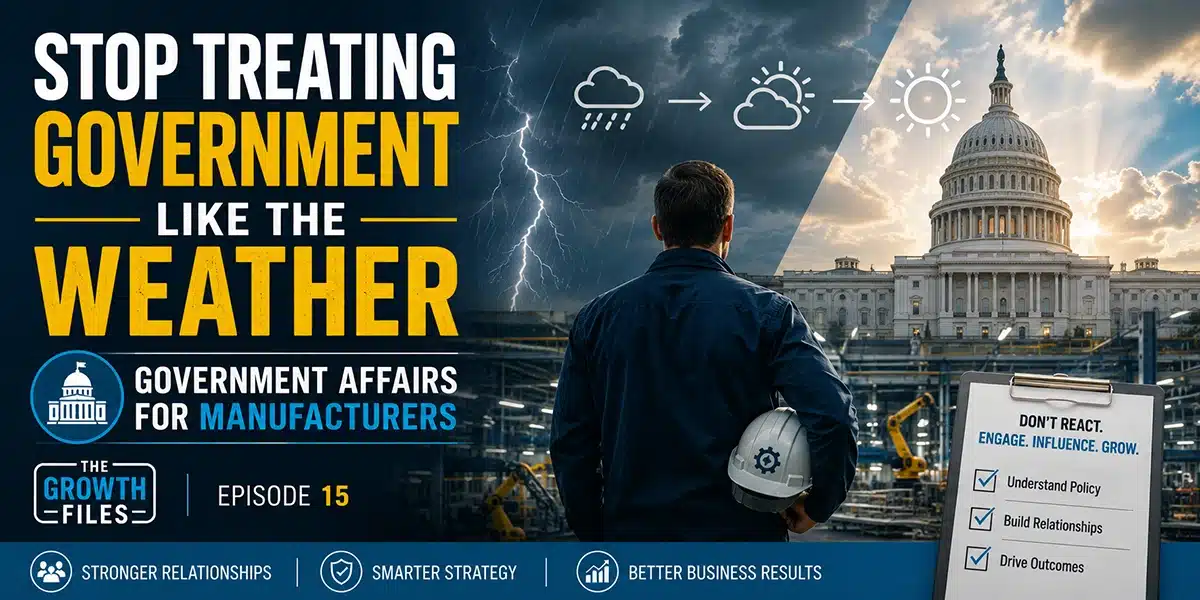
Most manufacturers do the math on their suppliers, their customers, their workforce and their capital. Then there is one stakeholder that regulates them, funds them, buys from them, and shows up at the federal, state, local and international level all at once. Very few companies put any process around that one.
Terry Szmagala spent nearly two decades at Eaton watching that gap from the inside, and he has a phrase for the reason it persists. Manufacturers treat government like the weather: something to be dealt with, never something to be influenced.
In Episode 15 of Growth Files, Sathish Kumar speaks with Terry Szmagala, who built and led government affairs at a $130 billion industrial manufacturer before founding an advisory practice for companies that are new to government engagement. The conversation covers where the money is sitting unclaimed, when a mid-size manufacturer actually needs a team, and the three questions that answer both.
Episode TL;DR
- •Government operates in three dimensions at once: regulator, funder and customer.
- •Manufacturers react when they are in pain, and the value sits in acting before that.
- •No manufacturer should expand without checking for state and local incentives first.
- •Build the analysis into the strategic review you already run. No new process required.
- •Tariffs hit case by case, and trade associations carry more weight than any single company.
- •Lobbying is educating your representative about impact, which is a different act from telling them how to vote.
- •Report government affairs the way The Economist reports world events, and skip vanity metrics.
- •The biggest mistake is assuming you have no ability to influence any of it.
In This Conversation
- 1.Why Government Reaches Companies That Feel Unregulated
- 2.The Three Dimensions: Regulator, Funder and Customer
- 3.The Money Manufacturers Leave on the Table
- 4.Build the Questions Into Strategic Planning You Already Run
- 5.Using Standards to Drive Demand for Your Product
- 6.Tariffs, Trade Associations and Telling Your Story
- 7.Global Operations and What AI Changes About Regulatory Tracking
- 8.Deciding Whether an Issue Is Yours or Everyone’s
- 9.How to Report Government Affairs Without Vanity Metrics
- 10.Community Engagement and the Goodwill Account
- 11.AI Regulation and the Lag Between Technology and Policy
- 12.When a Manufacturer Actually Needs a Government Affairs Team
About the Guests
Guest

Terry Szmagala, Founder of TGS Advisory. Nearly two decades at Eaton, the global power management manufacturer, where he served as chief counsel for the Fluid Power Group, chief counsel of the Industrial Sector, Senior Vice President of Public and Community Affairs and Corporate Communications, and Executive Vice President and Chief Legal Officer. Previously group counsel at Avery Dennison and an attorney with Squire Patton Boggs across its Cleveland, Washington DC and Kyiv offices. He now advises small and mid-size publicly traded manufacturers on government engagement.
Host

Sathish Kumar Mariappan, CEO and Co-Founder of CommerceShop and host of Growth Files. Sathish leads a revenue-first eCommerce consultancy for brands scaling from $2M to $25M, focused on conversion optimization, answer engine optimization and B2B manufacturing commerce.
Why Government Reaches Companies That Feel Unregulated
Two decades across legal, industrial leadership and government affairs produced one observation that shapes everything else in the conversation: government reaches deep into companies that would never describe themselves as regulated.
A pharmaceutical company knows it answers to a regulator. So does a bank, and so does an airline. A diversified manufacturer making components that go into somebody else’s finished product rarely thinks in those terms, and that is precisely where the blind spot forms.
Terry: “In reality, the government impacts your operations in so many different ways. And the challenge is actually to understand those ways and to see whether or not you can influence and actually direct and help influence government regulation rather than simply react to what government does.”
The distinction between influencing and reacting runs through the whole conversation. Reaction is what happens when a tariff lands or a regulation restricts a chemical the production process depends on. By then the company is solving a problem. The alternative starts earlier and asks where government could be creating opportunity.
The Three Dimensions: Regulator, Funder and Customer
The central framework is compact enough to hold in a strategy meeting.
Terry: “Government really operates in three dimensions, right? It’s a regulator, it’s a funder, and it’s a customer. And good manufacturers think of each of these three value streams and ask themselves: okay, how can I get government to help me, even if it’s a regulator?”
Each dimension has a matching question, and most companies engage only with the first.
The framing changes who owns the relationship internally. A company that sees only the regulator dimension routes government to legal and compliance. A company that sees all three has reason to involve strategy, finance and sales, which is a different conversation about resourcing.
The Money Manufacturers Leave on the Table
Companies miss out on funding and support constantly, and expansion is the clearest example.
Terry: “No manufacturer should ever expand without seeing whether or not there are local or state or federal incentives.”
The mechanics are straightforward. A manufacturer planning a $15 million investment to extend a product line and add onto an existing facility walks into a negotiation most companies skip entirely. State and local agencies run programs designed to create jobs, and manufacturers are a favored category. Tax credits are one common instrument, low-interest financing another.
Terry: “There’s nothing that a politician likes more than to say we’ve just created 50 new jobs in XYZ County.”
The incentive exists because the elected official needs the announcement, which means a company bringing jobs holds real leverage in a conversation it rarely starts. The check is straightforward: any capital project involving land, construction, renovation or headcount should trigger an incentives review before the commitment is made.
Build the Questions Into Strategic Planning You Already Run
The resistance from manufacturers is about cost and clarity. Hiring a government affairs person is an expense with an uncertain return, and the value proposition is hard to articulate before you have tried it.
The starting move avoids the hiring question entirely.
Terry: “The first exercise is really to work an analysis of government into your existing processes.”
A well-run manufacturer already conducts regular strategic reviews of its product lines, examining supply chain location, the robustness of end markets and the rest. Adding a short set of government questions to that existing review costs almost nothing and requires no new process, no new headcount and no standing consultant relationship.
Terry: “It’s a very simple process that you can begin to bake into your own existing processes. Then, once you identify the issues that you need to be addressed, you can then determine whether or not you need a lobbyist, whether or not you should use your trade association, whether or not you should work to create a consortium.”
A lobbyist is one instrument among several, and for many issues it is the wrong one. Trade associations carry shared industry problems. A consortium suits an issue affecting a handful of companies with no existing body to represent them. Choosing before diagnosing is what leads companies to buy the most expensive instrument for a problem that needed the cheapest.
Once the process exists internally, the ongoing outside cost drops sharply. Terry has installed it at a number of companies, and the point of installing it is that they can then run it themselves.
Identify the issues first, then choose the instrument. Companies that reverse it pay for a capability before knowing what they need it to do, which is what makes the next CFO conversation harder.
Watch the Full Conversation on YouTube
Terry walks through the incentive negotiation, the trade association playbook on tariffs, and how he reported government affairs to Eaton’s business leaders.
 Watch on YouTube →
Using Standards to Drive Demand for Your Product
The regulator dimension produces the least intuitive opportunity in the episode, illustrated here with electrical products.
Standards governing the use of circuit breakers in homes are set by a trade association. Individual states then choose whether to adopt those standards. A manufacturer making high-performing circuit breakers has a direct commercial interest in which way those states go.
Terry: “If you are a manufacturer of high-performing circuit breakers, you really should be out there helping states or lobbying states to raise their standards. Adopt the higher codes. So that really pushes the sales of your product.”
The question generalizes well beyond electrical.
Terry: “Do I make a product, or do I make a product that actually goes into a product for my customer, that a government would want to incentivize the use of?”
That second clause carries most of the value. A component maker two steps removed from the end market still benefits when a safety standard tightens, because the mandate flows down the supply chain. One client sold what everyone internally regarded as a commodity, and only recognized on examination that the end consumer was selling into the safety market. Raising the relevant standard would have driven substantial additional volume for a product nobody thought had a regulatory angle at all.
Tariffs, Trade Associations and Telling Your Story
Tariffs are the live issue for most manufacturers, and they land differently on each one.
Some manufacturers welcome them, because they compete directly against foreign imports. Many more dislike them, because raw material costs rise. How tariffs land depends entirely on where a company sits in the supply chain, and a domestic manufacturer importing inputs can face the cost without any of the protection.
For an issue at that scale, the individual company has limited reach.
Terry: “Individual manufacturers are obviously not going to be able to impact tariffs individually. So you really need to band together, and this is where trade associations are extremely helpful.”
That puts a specific test to your own association: is it conveying to the Department of Commerce what these tariffs actually do to businesses like yours?
One scenario where associations have moved the needle involves products with no domestic production at all. A heavy tariff there raises costs across the board while creating zero additional US content. Commerce is frequently unaware, and somebody has to tell them.
On the direct route to your own representative, a common misunderstanding about lobbying needs correcting.
Terry: “People sometimes think that lobbying is trying to get a representative to vote the way you want them to vote, and that’s really not the case. What’s more important is that your representative understands the impact of the policies that are being imposed upon you.”
The practical version is a conversation with no ask attached. Sit down with your congressman, explain that costs have risen, that the increase stays on your books, and that hiring has slowed as a result. Whether anything changes immediately is a separate question. The honest timeline is a long battle, where the goal is a representative who understands your business when an opportunity does arise.
Terry: “If I had a nickel for every time I had an elected representative thank me for helping them understand the impact of their regulation on the broader economy, it’d be pretty significant.”
That reframe lowers the barrier considerably. Educating a representative about your cost structure takes no lobbyist, no budget and no political position. It takes a meeting.
Global Operations and What AI Changes About Regulatory Tracking
Manufacturers selling across the US, Europe and Asia face a regulatory environment that is stubbornly local. Rules vary country by country and state by state, and the tracking burden has historically been the blocker.
Terry: “In the past it was very labor intensive and cost prohibitive to really have an in-depth analysis of all of the legislation that is impacting your business, the different regulations in different countries. So oftentimes companies just decided, I don’t have the resources to track this.”
That constraint is what shifts. Companies are now deploying AI tools to become aware of regulations affecting them across more jurisdictions than they could previously monitor, and to assess whether they can weigh in on regulatory changes underway.
The strategic upgrade runs deeper than the efficiency gain. Monitoring that was cost prohibitive becomes routine, which moves multi-jurisdiction regulatory awareness from an enterprise-only capability into reach for mid-size manufacturers. Awareness is the precondition for everything else in this episode, since influencing a rule requires seeing it first.
Listen to the Full Episode on Spotify
The audio version covers the incentives conversation, the Economist reporting method, and Terry’s closing advice to manufacturing CEOs.
Listen on Spotify →Deciding Whether an Issue Is Yours or Everyone’s
Once an issue surfaces, the response depends on a two-step diagnostic. First, understand the issue precisely. Second, establish whether it is shared or specific to you.
A country imposing strict labor regulations that push up costs is a shared problem. Every manufacturer operating there faces it, which makes your own lobbyist a poor use of money and a trade association the obvious vehicle. A regulation that hits one very specific product you happen to make is a different situation, and that is where dedicated advocacy earns its cost.
The same logic applies to competitive impact. A European rule restricting a chemical in your product matters less if every competitor absorbs the same restriction and passes along the same cost. It matters considerably more if the burden falls on you alone.
Terry: “Is the juice worth the squeeze?”
Then the line that gives this episode its argument.
Terry: “The biggest mistake manufacturers make is that they treat government like the weather. It’s something to be dealt with as opposed to impacted.”
The metaphor names an assumption most companies leave unexamined. Weather is genuinely uninfluenceable, so treating it as a planning input is rational. Regulation is written by people who can be informed, and the two get filed in the same mental category by default. Terry’s counter is direct: test what can be influenced before concluding nothing can.
How to Report Government Affairs Without Vanity Metrics
How to communicate what a government affairs function is doing comes up more than almost any other question. Manufacturing runs on quantified data: cost outs, scrap rates, efficiency, labor rates, procurement performance. Government sits outside that discipline.
Terry: “Government’s a harder thing to measure, but just because it’s harder doesn’t mean it’s not important.”
The solution at Eaton borrowed a format from journalism. The Economist opens each edition with two pages of short paragraphs summarizing world events in three or four sentences each. Policy updates got the same discipline: the issue, where it stands, the expected next steps, full stop.
Terry: “We tried to avoid metrics that were more vanity metrics, like this is the number of congressmen we met, or this is the number of meetings we had. Those metrics show activity, but they don’t show value.”
The same distinction applies to any function that measures badly. Meeting counts describe effort. An issue tracker with status and next steps describes progress, which is what a business leader can act on.
Two operational details made it work at Eaton. Updates covered the negative alongside the positive, including tax legislation the company disliked, because transparency is what makes the reporting credible. And updates were organized by business unit so a manager could find what applied to their operation, which kept it a management-level conversation and kept people reading.
Community Engagement and the Goodwill Account
Community affairs scales with resources, and a smaller manufacturer may reasonably decide the expense sits out of reach. What stays affordable at any size is enabling employees who already want to participate.
A day of service, or time off to sit on a nonprofit board, produces employee engagement and goodwill at modest cost. It also builds a relationship that pays off in one specific circumstance.
Terry: “If you ever need to be thought of positively by the local mayor, or you accidentally polluted the water because of some failure of your pumping system, they’re going to be more positively disposed to you if they know you and you’ve been in the community.”
That is the honest case for community investment. Relationships built before a problem are the ones available during one, and the employee engagement benefit arrives regardless, which makes it a reasonable bet even for a manufacturer that never draws on the goodwill.
AI Regulation and the Lag Between Technology and Policy
AI regulation develops against a structural constant.
Terry: “Government is gonna lag tech. The tech is gonna be out in front and government’s gonna be catching up.”
The read on policymakers here is more generous than the prevailing mood. Most of them want to get it right, and most have never run a manufacturing operation, which means they can misjudge what a regulatory decision does downstream. The useful contribution a manufacturer can make is explaining unintended consequences before they are locked in, usually through a trade association.
On job displacement, government capacity to prevent it looks limited, and the historical parallel is blunt: the buggy whip manufacturers stayed unemployed after the motor vehicle arrived. The legitimate policy question is retraining and how to smooth the transition, complicated by nobody knowing what work looks like in five or ten years.
Terry: “There are lots and lots of unknowns out there. And we’re all gonna learn together.”
His expectation for how regulation actually arrives is worth planning around.
Terry: “AI is a technology, that’s just a tool. What is gonna make the difference is how AI is deployed in various specific applications.”
Policymakers are largely in wait-and-see mode, and the eventual rules look set to arrive hyperlocalized, application by application, with the film industry already generating policy fights. For a manufacturer, that means watching for rules attached to specific deployments in specific jurisdictions, well before any comprehensive AI act arrives.
When a Manufacturer Actually Needs a Government Affairs Team
The question Sathish returns to is the practical one: at what revenue does a manufacturer need dedicated resource? No revenue threshold answers it.
Whether it makes sense depends on the regulatory intensity of the business more than the revenue line. A pharmaceutical company has government affairs at any size, and so does a bank or an airline, because a regulatory authority governs the license to operate. A diversified manufacturer usually needs more scale before the investment pays. Beyond that it runs case by case, and the honest question is how a company works out whether it is worth it.
The harder case is the one Terry flags as most common: a manufacturer that has never thought of itself as regulated, making products sold to others who incorporate them into something else. The regulatory exposure is real and indirect, which makes it invisible without deliberately looking.
Terry: “I don’t think they need a separate team unless they’ve identified issues that they believe could really add value to the business.”
What every manufacturer can afford is a short set of questions inside the planning process it already runs:
1) Does government regulate your end markets? Is there an end market regulation that could help or hurt the sale of your product?
2) Does government buy your product? Federal, state or local, directly, or from your customers in a way that flows back to you?
3) Is there R&D money available? Grants, small business loans, or funding to help develop your products.
Terry: “Once you get the answer to those questions, you’ll have a better idea of whether or not you need to create a team. You don’t want to create a team just to create a team.”
Sathish asks whether government becomes a strategic partner or stays a regulator. The answer reframes the whole function through a stakeholder lens most manufacturers will recognize immediately.
Companies build dedicated functions for every major stakeholder. HR handles employees, sales handles customers, procurement handles suppliers. Government regulates you, funds you, buys from you, and operates at four levels simultaneously, and almost no company puts comparable process around it.
Terry: “You’ve got an IR department. What is your job? To tell your company’s story to the analyst community, so the analyst community understands why your company is poised for success. Are you doing that with your government stakeholders as well? Do they know the story?”
The investor relations parallel carries further than any compliance framing. IR exists because a company decided that how one audience understands its story affects enterprise value. Government affairs makes the same claim about a different audience, and Terry’s test is concrete: if you ran into your congressman, would they be able to say what your company does and why it matters locally?
The closing advice to a manufacturing CEO stays deliberately small.
Terry: “Don’t feel that you need to get all the answers right away. Start small and then just incorporate some basic due diligence strategic planning questions into your strategic review and then see where it goes.”
Running the questions may reveal a commodity product in a lightly regulated market where the effort is unwarranted, and that is a legitimate finding. What the questions rule out matters as much as what they surface, and neither is knowable until somebody asks. That holds for a company in steady-state operations as much as one planning an expansion.
Your Government Affairs Checklist
Start with the first three. They fit inside the planning cycle you already run.
- •Add three questions to your next product line review: does government regulate our end markets, buy from us, or fund work like ours
- •Check state and local incentive programs before committing to any expansion, renovation or significant hiring
- •Ask whether your trade association is conveying your specific tariff and cost impacts to the Department of Commerce
- •Identify which of your current regulatory issues are shared industry-wide and which are specific to your products
- •Book one meeting with your local representative to explain your cost structure, with no ask attached
- •Map which standards bodies govern your products, and which states have adopted or declined them
- •Set up AI-assisted monitoring for regulations across every jurisdiction where you operate
- •Replace meeting-count reporting with a status-and-next-steps summary organized by business unit
- •Give employees paid time to serve on local boards or volunteer, then track participation
Government Affairs FAQ
What does government affairs do for a manufacturer? It manages the relationship with government across three dimensions: regulator, funder and customer. That covers influencing regulations that shape end markets, pursuing incentives and research funding, and positioning for public procurement, alongside conventional compliance work.
When does a manufacturer need a government affairs team? When the business has identified specific issues where government engagement would add measurable value. Regulatory intensity predicts the need better than revenue does. Heavily regulated sectors need it at any size, while diversified manufacturers usually need more scale first.
How do you measure government affairs performance? By outcome. Meeting counts and legislator introductions describe effort. A concise issue tracker showing what is being worked, where it stands and what happens next describes progress, organized by business unit so leaders see what applies to them.
Can a small manufacturer influence government regulation? Yes, mainly through trade associations for industry-wide issues and direct education of local representatives for company-specific ones. Terry’s point is that lobbying at this level means helping a representative understand your business impact, which sits well apart from asking for a particular vote.
Ready to Find Out What Government Is Worth to Your Business?
Most manufacturers have an awareness problem more than a compliance problem: incentives left unclaimed, standards that could expand their market, and a stakeholder nobody owns. CommerceShop works with manufacturers and B2B brands on the systems behind growth, from process and data readiness through to answer engine and generative engine visibility.
Book a Call With CommerceShop →Keep the Conversation Going
This is Episode 15 of Growth Files by CommerceShop, where operators and advisors share what works in manufacturing, commerce and AI.

