
Reshoring Reality Check: What it Takes to Bring Manufacturing Jobs to the US (Growth Files Ep. 8)
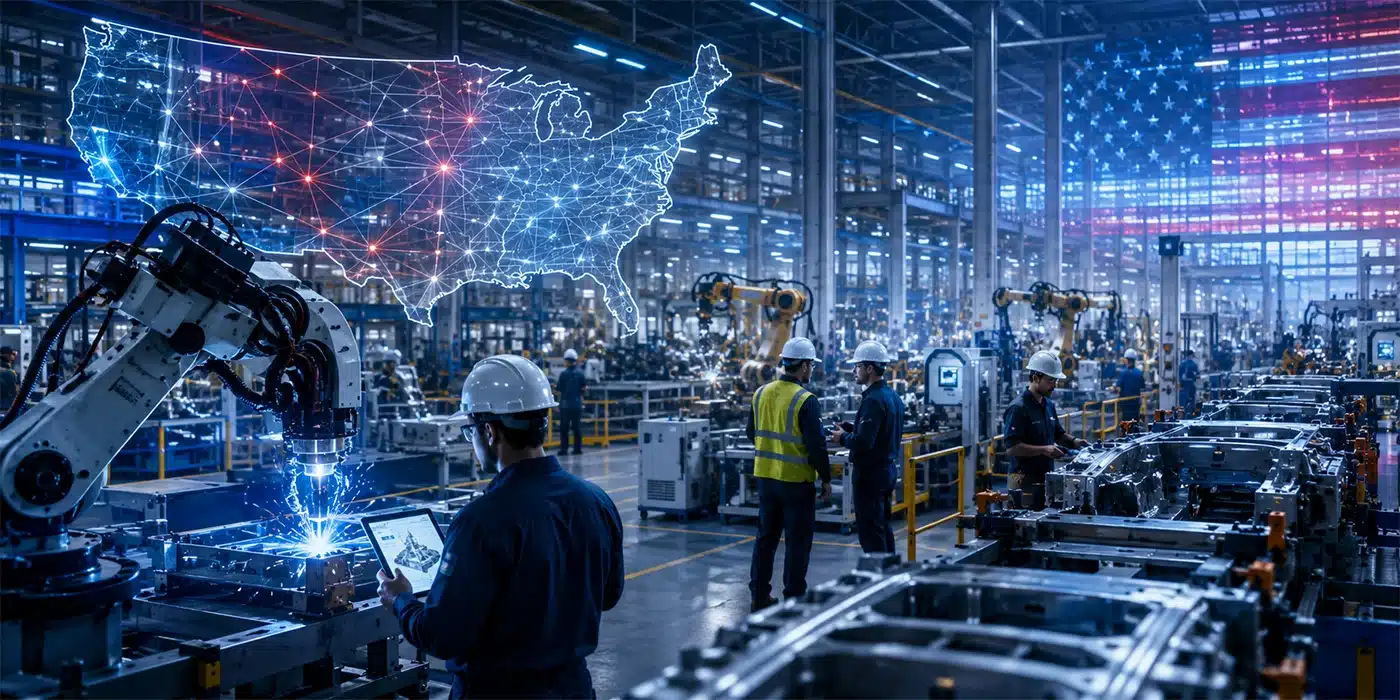
You’re a C-level executive at a mid-size manufacturer. Your board is asking when you’ll bring production back from China. Tariffs keep climbing. Political pressure keeps mounting. Politicians keep promising a manufacturing renaissance.
But every time your team runs the numbers, the answer comes back the same: not yet. Tariffs are unstable. Infrastructure isn’t ready. The skilled workers don’t exist at the scale you’d need.
This isn’t hypothetical. The Reshoring Institute surveyed 18 C-level executives across 16 industries for the state of New York. Everyone said the same thing: they’re doing nothing. Not because they don’t want to reshore, but because the environment is too unstable to commit capital.
Manufacturing has been flat for over a year. The reshoring tsunami that politicians promise is coming back in raindrops.
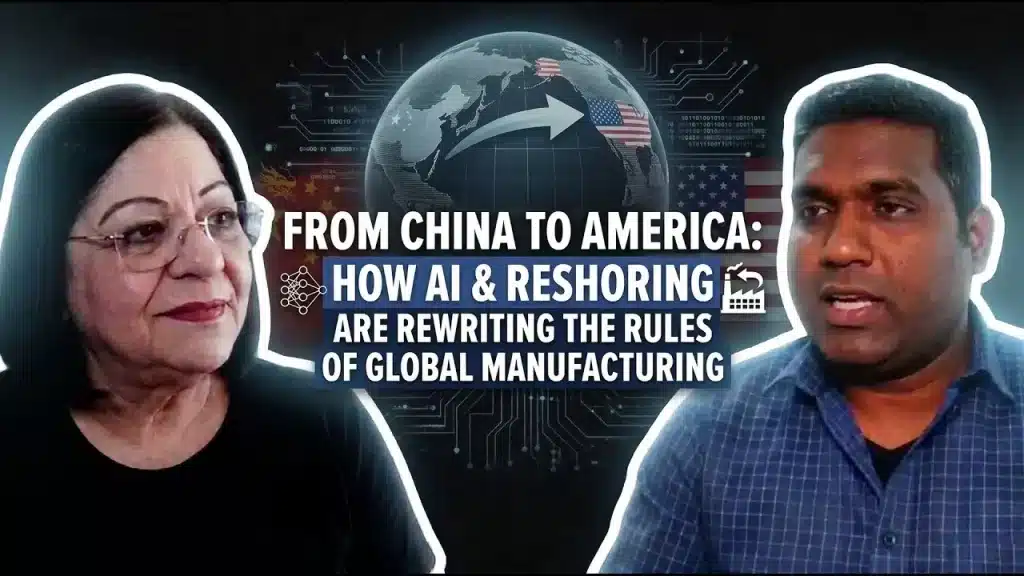
In this episode of Growth Files, we sit down with Rosemary Coates, who has spent 40 years in supply chain work and founded the Reshoring Institute 11 years ago.

Rosemary Coates is Founder of the Reshoring Institute and President of Blue Silk Consulting, a global supply chain advisory serving Fortune 100 clients like SAP and KPMG. She is a licensed US Customs Broker with 40 years of experience, specializing in reshoring strategy and manufacturing transformation.


Sathish Kumar is CEO of CommerceShop, an eCommerce consultancy focused on revenue-first optimization for brands scaling from $2M–$25M. He specializes in AEO, conversion optimization, and helping manufacturers adapt to AI-driven buyer journeys across complex B2B commerce ecosystems globally.
Episode TL;DR
- Reshoring is real, but manufacturing job growth has been flat for over a year. Infrastructure, the electrical grid, and skilled worker shortages all stand in the way.
- The Reshoring Institute surveyed 18 C-level executives across 16 industries. Every single one said they were doing nothing because the tariff environment is too unstable.
- About 80% of the companies Rosemary works with are looking at Mexico rather than the US. Low wages, USMCA duty-free access, and proximity make it the default.
- If your product has more than 50% labor content, there is no economic case for US manufacturing. Automation is what makes reshoring viable.
- The US does not have a job shortage. It has a skill shortage. Today’s manufacturing jobs mean running robots, not sitting at sewing machines.
- AI is being rapidly adopted in the supply chain for forecasting, planning, tracking, and predictive maintenance. The jobs are not disappearing. They are changing.
In this conversation:
- Why the manufacturing renaissance hasn’t shown up in the numbers
- The real reasons C-level executives are frozen on reshoring decisions
- Which industries are reshoring and which never will
- Why Mexico is replacing China for most companies that are moving
- How AI is being adopted in supply chain decisions
The Reality Check: Is Manufacturing Actually Coming Back?
Sathish: What’s the biggest misconception people have about reshoring right now?
Rosemary: Politicians keep saying manufacturing is coming back and tariffs will force companies to set up production here. That’s a misconception.
Sathish: What’s making it so difficult?
Rosemary: You may not have the funding to build a billion-dollar plant. We’re not going to bring back 35-cent-an-hour t-shirt production. You cannot make an economic case for that. What does come back is more sophisticated manufacturing.
Most companies have the will to invest in US manufacturing. Will alone isn’t enough.
Manufacturing has been absolutely flat in the last year, with little to no growth in manufacturing jobs.
Beyond capital and economics, three other gaps are slowing the pace:
- Infrastructure: Roads, bridges, ports, and the electrical grid are behind where they need to be. Goods can’t move efficiently and the grid is contested.
- Skilled workforce: Sophisticated manufacturing requires a different skill set, and the US has a shortage of those workers.
- Tariff instability: Executives can’t make long-term capital decisions while tariff policy keeps changing.
Reshoring is real. But the jobs are coming back in raindrops, not a tsunami.
▶ Listen to the full episode on Spotify for Rosemary’s complete breakdown.
How the Reshoring Movement Actually Started
Sathish: What drew you into this work?
Rosemary: I’ve been a management consultant for 35 years. Before that, I worked at HP. I’ve been doing supply chain work for 40 years.
In 2012, during the presidential election, Mitt Romney and Barack Obama were both China-bashing. They were saying all our economic woes were due to China. Currency manipulation, human rights issues, and stealing American jobs. All of it was true.
At the time, I had been helping companies offshore in China. I felt like I couldn’t tell anyone what I did for a living.
Sathish: And the Reshoring Institute grew out of that?
Rosemary: Some of the executives I worked with asked a different question: would it be possible to bring any manufacturing back to the US? That election sparked the interest, and it was the beginning of the reshoring movement.
Two years later, my team developed a methodology for evaluating whether a company could make the economic case to bring manufacturing back. Out of that grew the Reshoring Institute.
The Institute has been operating for 11 years as a 501c3 nonprofit and nonpartisan organization. The nonpartisan stance matters because the Institute tries to tell the truth and not take sides politically. Its work spans:
- Research, case studies, white papers, and surveys
- Small consulting projects for companies evaluating reshoring decisions
- Site selection for US manufacturing
- Made in USA labeling, which is more complicated than companies expect
- Supply chain redevelopment, finding US suppliers for domestic networks
- A graduate student internship program affiliated with 20 universities
Which Industries Are Actually Reshoring
Sathish: Which industries are moving fastest right now?
Rosemary: Some industries are ahead of others. Semiconductors are definitely coming back, largely because of the Chips and Science Act funding. These are billion-dollar operations with heavy automation, and they take five to ten years to build. Factories are under construction in Arizona, New Mexico, Idaho, Texas, Ohio, and upstate New York.
Sathish: What else?
Rosemary: Pharmaceuticals. During the pandemic, we discovered we don’t make any building-block pharmaceuticals for things like antibiotics. If we couldn’t get precursor chemicals from China and India, we couldn’t make antibiotics in the US. That became a focus area for federal funding.
The Infrastructure Act also funded electric vehicle and battery production. What we’re seeing come back are advanced industries where federal funding is driving the investment.
There’s also general interest across the board in more domestic sourcing of products and parts for production lines.
But the bright spots are concentrated in industries that have received funding from the US government. Federal funding is driving the reshoring that’s actually happening, not tariffs.
What Comes Back and What Never Will
Sathish: Are companies adapting to automation enough that more manufacturing will return?
Rosemary: Let me give you an example. If you make men’s shirts and sell them at Target or Kohl’s, there’s a lot of labor involved. You have to sew on the collar and the sleeves. More than 50% of the value of the product is based on labor. You need a low-cost labor environment.
Sathish: And textiles?
Rosemary: If you make the textiles for the shirt, the fabric itself, textile production is fully automated. There are no people weaving things these days. If you walk into a textile factory, it’s all machinery.
A textile company with a fully automated site has the potential to locate in a lot of places. We’ve seen growth in textiles in the Carolinas, Alabama, and Mississippi.
But thousands of people sitting at sewing machines all day long? That is not the kind of manufacturing that was ever in the US, at least not since the industrial revolution. It’s not coming back.
What returns to the US:
- Automated production with low labor content
- Manufacturing where labor can be extracted through automation
- Sophisticated, advanced industries
What doesn’t:
- Labor-intensive assembly where labor is more than 50% of product value
- The kind of mass sewing and assembly that hasn’t been in the US since the Industrial Revolution
The manufacturing that does come back pays better. It’s beyond minimum wage. This is middle-class work.
The Tariff Trap: Why C-Level Executives Are Doing Nothing
Sathish: Are the tariffs effectively bringing back manufacturing jobs?
Rosemary: It’s not just my opinion. The tariffs were designed for a couple of reasons. Not only to assist manufacturing in coming back, but to punish trading partners the administration felt were taking advantage of American consumers.
We did a survey for the state of New York. They wanted to know how tariffs were affecting reshoring decisions.
Sathish: What did you find?
Rosemary: We interviewed 18 C-level executives across 16 industries. California, Arizona, Texas, New York, up and down the East Coast. We asked: Are you making an investment now because of the tariffs?
To a person, every executive told us they were doing nothing. It’s too difficult to make a decision in an unstable environment. They would like to move manufacturing back, but until the tariffs stabilize, they’re not making investments. They’re not building. They’re not hiring.
This was a surprise to me. I thought we’d find at least a few who said they were reshoring. But it represents pent-up demand. Once things stabilize, we’ll see more investment.
The signal is hard to misread. Tariffs aren’t producing the manufacturing growth they were sold to produce. Executives say they want to move production back, but the environment is too unstable to commit capital. Until policy clarity returns, the industry stays in waiting mode, and the manufacturing job numbers stay flat.
The Infrastructure Problem No One Talks About
Sathish: Beyond policy uncertainty, what are the underlying obstacles?
Rosemary: Our infrastructure is poor. We’re repairing some roads and bridges under the Infrastructure Act, but almost everyone in America can relate to potholes and bridges that feel insecure. Our ports are behind in world technology.
Sathish: And energy?
Rosemary: The electrical grid is another huge problem. I talked to an investment banker from New York whose area was funding energy projects. He asked, “Do you really think it’s coming back?” I said yes, there’s some bright hope.
He said, “We don’t have enough energy to support that many factories. Even if we built a thousand new factories, there’s no electricity to support them.”
Two compounding forces sit on top of the basic infrastructure gap:
- Data center demand on the grid: The same electrical capacity that can’t power new factories is also being aggressively consumed by data centers. Industrial-scale electricity demand and AI-scale demand are competing for the same finite supply.
- A workforce that hasn’t kept pace: Skilled workers for the sophisticated manufacturing that’s coming back aren’t available at scale. The will to invest exists at most boards. But will alone isn’t enough. You need power, transport, and people simultaneously.
It’s a complicated economic issue overall.
China Plus One: The New Manufacturing Strategy
Sathish: What are companies doing about their China exposure?
Rosemary: When I wrote my book, 42 Rules for Sourcing and Manufacturing in China in 2009, the economics were simple. Most companies offshored to China because it was clearly cheaper. It could be a quarter of the price.
The economics have changed. China is not a low-cost country anymore. Wage rates have gone up significantly.
We did a study comparing wages across 10 job categories in 12 countries. China’s wages are now squarely in the middle. The low end is India, Vietnam, and Mexico.
Sathish: So, where are companies moving instead?
Rosemary: Companies are moving to a China plus one or China plus two strategy. China plus one might mean China plus Mexico. China plus two might be China plus Vietnam plus the US. Manufacturing in multiple locations instead of putting all your eggs in one basket.
Vietnam was a hot spot, but it only has 95 million people and it’s full. It’s hard to find a factory in Vietnam. Some companies are moving to India, Taiwan, and Indonesia.
The shift isn’t about finding a single replacement for China. It’s about spreading risk across geographies, which is the lesson the pandemic taught most manufacturers when factories closed and parts couldn’t ship.
Why Mexico Is Replacing China
Sathish: Why is Mexico such a strong choice for companies leaving China?
Rosemary: There are several advantages, and they stack up fast. Mexico is relatively sophisticated as a manufacturing location. Proximity matters. You can drive across the border instead of putting the product in an ocean container.
Then there’s USMCA. If the product’s materials and labor are developed in Mexico, you can claim the country of origin as Mexico and bring it into the US duty-free. A product that might face an 80% tariff from China faces zero from Mexico.
Sathish: And the cost side?
Rosemary: Mexico’s minimum wage is around $3.12 an hour. The cost of labor is very low compared to most alternatives.
Three more forces are flipping Mexico from “alternative” to “default destination”:
- A rapidly building industrial base: Particularly in automotive, big factories are under construction. Tesla is building a Gigafactory in Monterrey, with electronics and consumer goods manufacturers following.
- An actively pro-business federal government: Mexico’s new president, Claudia Sheinbaum, has been in office about a year. She’s focused on building business in Mexico, has suggested up to 100 industrial parks, and is working to address the cartel security issues that have historically deterred investment.
- A measurable shift in pipeline: About 80% of the companies the Reshoring Institute works with are now interested in Mexico, primarily for tariff and geopolitical reasons.
For most companies leaving China, Mexico is the default destination.
Reshoring is not about a manufacturing renaissance that brings every job back. It is about giving manufacturers a clear-eyed framework for which production belongs in the US, which belongs in Mexico or elsewhere, and how to make the math actually work in an unstable policy environment.
This conversation covers where the real opportunity is and what has to be in place before any of it works.
The Skill Shortage Behind the Workforce Crisis
Sathish: Where’s the disconnect on manufacturing jobs?
Rosemary: Manufacturing is evolving. The skills required today are very different from those they were 25 or 30 years ago.
My grandfather worked at Hazy Taylor in Warren, Ohio. They made drinking fountains. He was a metalworker, and he’d come home smelly and greasy. He’d want to give me a hug, and I’d say, “No, too gross.” That was manufacturing 50 years ago.
Today’s environment is full of computers. People on the manufacturing floor are moving inventory along via computer systems, testing products, and working in clean environments. In Silicon Valley, you have to get into a bunny suit to avoid contaminating the manufacturing environment.
Sathish: Are students interested in these careers?
Rosemary: We’re affiliated with 20 universities, trying to introduce students to manufacturing. I’m not necessarily talking about the shop floor. There are all kinds of jobs: supply chain, planning, forecasting, and procurement.
You need engineering skills because manufacturing is much more sophisticated. Or people with mid-range crossover skills: community college background, basic math to set planes and angles, writing skills, the ability to run or program a machine tool. Today we want people running the robots that put pegs in holes, not putting pegs in holes themselves.
We don’t have a job shortage. We have a skill shortage. The jobs exist. The right workers don’t.
The skills profile has shifted dramatically. These aren’t minimum wage jobs anymore. They’re middle-class wages for skilled work. Workforce development takes years to produce graduates ready for the workforce.
How AI Is Reshaping Supply Chain Decisions
Sathish: How is AI being adopted in manufacturing and supply chain?
Rosemary: The global supply chain is very data-intensive. You’re constantly looking for products, quantities, movements, suppliers, where they’re located, when they shipped, and how that fits with the production schedule.
AI is a perfect match. We’re seeing rapid adoption in forecasting, planning, tracking, tracing, and notifications when a part isn’t moving. Most software supporting the supply chain has AI components built in.
Sathish: And on predictive maintenance specifically?
Rosemary: It’s becoming critical. We’re working with a midsize machine shop in Morgan Hill, south of San Jose. The CEO told us, “If you don’t plan for maintenance of your machines, the machine will do it for you. The machine will break down and do it for you.”
Two other shifts are running alongside AI’s data-layer adoption:
- Sensor-driven machine synchronization: Modern factories use sensors and synchronization software based on the theory of constraints to smooth product flow between machines that work at different paces. The goal is to keep each station fed without inventory pile-ups between stages.
- KPI software with AI flagging: Heavy investment is going into software that continuously measures efficiency, products per hour, and downtime, with AI surfacing where constraints are forming so operators can resolve them in real time.
On the workforce side, Rosemary expects some job elimination because AI makes data work more efficiently. But for the next five to ten years, the larger shift is in skills required, not headcount. Supply chain jobs aren’t going away. They’re changing into something different, with AI tools embedded in everyday work.
The Reshoring Decision Framework
Sathish: What’s your framework for an executive evaluating reshoring?
Rosemary: The first thing we do is evaluate a costed bill of materials. We look at how much labor is involved in building the product. That’s the first decision point.
If you have a lot of labor in your product, there’s no way we can support it in the US. If you’re sewing men’s shirts, you have to look for a low-cost labor environment.
Sathish: And then?
Rosemary: The second step is risk. Our eyes were opened during the pandemic. Companies suddenly understood how risky their global supply chains were when they couldn’t get parts from China. They needed to de-risk.
Then you understand where in the world you could manufacture and why. Are you close to your markets? Are you taking advantage of a low-cost environment? Are you looking for sophisticated engineering?
Before I started helping companies with reshoring, the decision was easy. A CEO would say, “Get me to China.” Today’s decision involves many more variables: cost, geopolitics, climate change, and market growth. AI is helping companies work through them.
The Reshoring Decision Framework Rosemary uses:
- Costed bill of materials analysis: Above 50% labor content, and the US isn’t viable
- Risk assessment: Where is your supply chain concentrated, and what happens if that geography becomes inaccessible?
- Market proximity: Where are your customers?
- Capability needs: What engineering sophistication does your product need?
- Multi-variable modeling: Cost, geopolitics, climate change, market growth, often with AI assistance
The “get me to China” era is over.
What Success Actually Looks Like
Sathish: What does success look like for the Reshoring Institute?
Rosemary: I would like to see the backbone of manufacturing come back to the US. More sophisticated manufacturing. That’s our message: let’s bring back what’s appropriate to bring back.
I’m optimistic about the future. But I’m also realistic. What should be coming back is sophisticated manufacturing that requires different skills, pays better wages, and is more appropriate from a green perspective. We are seeing interest. Some movement at this point.
The strategy for B2B leaders is clear: align your sourcing decisions with the kind of manufacturing the US can sustain. If your product depends on low-cost labor, plan for international production. If it depends on advanced engineering or automation, US manufacturing is increasingly viable.
The Reshoring Institute publishes its research, case studies, white papers, and surveys for free at reshoringinstitute.org. Everything is downloadable, with no sign-up required. There’s also a dedicated tab on Mexico manufacturing, given the volume of interest in that destination.
What B2B Manufacturers Must Do Now
The reshoring playbook isn’t about waiting for political clarity. Manufacturers who succeed will focus on fundamentals.
1. Run the costed bill of materials analysis first
Calculate labor content as a percentage of product cost. If labor is more than 50% of value, you have to look for a low-cost labor environment. If labor can be extracted through automation, US manufacturing may be viable.
2. Build a China Plus One strategy now
Identify your second location before policy forces you to. Mexico, Vietnam, India, or the US, depending on your product mix.
3. Take Mexico seriously
About 80% of the companies the Reshoring Institute works with are interested in Mexico. USMCA, low wages, proximity, and a pro-business government make it the leading destination.
4. Plan for the skill shortage, not the job shortage
The workforce gap is about not having enough people with the right skills. Invest in workforce pipelines, internships, and partnerships with technical colleges now.
5. Adopt AI-enabled supply chain tools
Forecasting, tracking, predictive maintenance, and decision modeling are mature enough to deliver ROI today.
6. Stay patient on tariff-driven moves
Don’t make ten-year capital commitments based on unstable policy cycles. Be ready when tariffs stabilize.
Ready to Understand How AI Answer Engines Perceive Your Manufacturing Brand?
While you’re navigating reshoring decisions and supply chain transformation, AI answer engines are shaping how your buyers discover and evaluate you before they ever talk to your sales team.
We run prompt-based AEO testing across your product families to show you:
- Which answer engines cite you vs. competitors
- Where citations come from (your site, distributors, third parties)
- What blocks visibility across your content ecosystem
- Which high-impact pages to fix first for maximum citation lift
Get your AEO visibility snapshot →
No one-size-fits-all. No fluff. Built for eCommerce.
Keep the Conversation Going
This is Episode 8 of Growth Files by CommerceShop, inside stories and strategies from manufacturing and B2B leaders navigating the shift to AI.
Also Watch ←
- Episode 7: Agentic AI in Retail: What Every Commerce Leader Needs to Know Right Now
- Episode 6: Why Most AI Investments in Manufacturing Fail (And How to Fix It)

