
Retail Media and AI: The Two Bets No Retailer Can Sit Out (Growth Files Ep. 9)

You run a retailer doing five million dollars a year. Your board keeps asking about retail media because Amazon seems to print money from it. At the same time, your customers are starting to shop by asking an AI chatbot what to buy, and you have no idea whether that helps you or quietly routes your buyers somewhere else.
Every time you look closer, the picture gets more complicated. Around 70 to 75% of all retail media spending already flows to Amazon and Walmart. The growth is real, but the giants are taking most of it.
So is retail media a genuine opportunity for a smaller retailer, or a distraction that sends your own customers to someone else’s checkout?
Retail media is not a winner-take-all game. Every new channel takes a slice. None of them takes the whole pie.
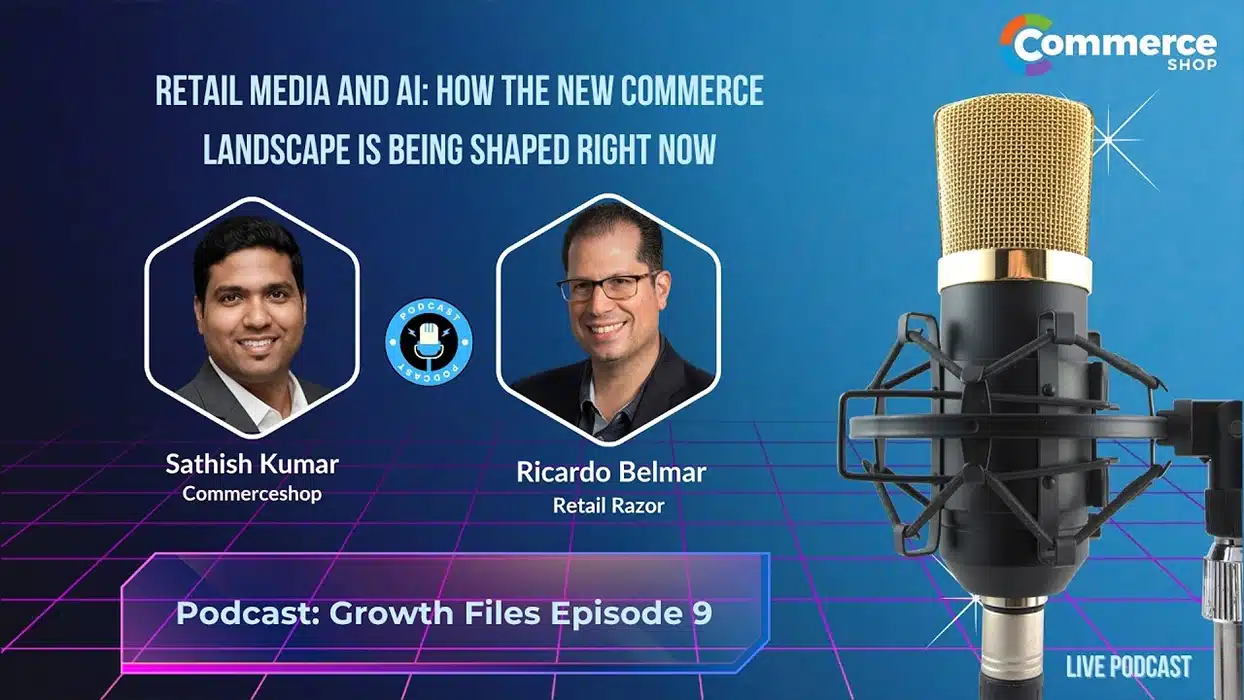
In this episode of Growth Files, we sit down with Ricardo Belmar, who has worked on the technology side of retail for close to 25 years and now runs the Retail Razor Podcast Network.

Ricardo Belmar is a globally respected retail thought leader, podcast host, and producer, and the founder of the Retail Razor Podcast Network. A former retail go-to-market executive at Microsoft, he has spent close to 25 years on the technology side of retail and is active across several retail industry alliances.


Sathish Kumar is CEO of CommerceShop, an eCommerce consultancy focused on revenue-first optimization for brands scaling from $2M–$25M. He specializes in AEO, conversion optimization, and helping manufacturers adapt to AI-driven buyer journeys across complex B2B commerce ecosystems globally.
Episode TL;DR
- Retail media and AI are the two things no retailer can sit out. AI either threatens retail media or makes it stronger.
- Retail media grew out of Amazon’s sponsored search placements and spread to Walmart, Target, big box chains, and grocers. The real product is not the ad slot, it is the first-party customer data.
- Retail media spend is growing roughly 20 to 25% year over year, but about 75% of it goes to Amazon and Walmart. The pie is still growing fast.
- Grocers stand to gain the most from retail media because of how their customers shop. Automotive brands lean in hardest as advertisers.
- AI projects that try to replace people tend to fail, while projects that augment existing teams tend to succeed.
- Agentic AI and instant checkout are a new channel, not an existential threat.Like every channel before it, it will coexist rather than take over.
In this conversation:
- How retail technology went from a secret to a strategy
- Where retail media came from and who it actually works for
- Whether sending customers away ever pays off
- Why most AI projects fail and which ones win
- How agentic AI changes the way people discover products
The Two Bets No Retailer Can Sit Out
Sathish: What is one thing retailers today should not ignore?
Ricardo: There are really two areas. One is AI in retail broadly, which is true for almost any industry, but especially retail, because retail has the most to gain from all the different flavors of AI. The other is retail media, also called commerce media networks, which is a real margin and profit driver, especially for larger retailers.
Sathish: And the two are connecting?
Ricardo: They are starting to intersect more and more. Depending on your point of view, it is either a crisis moment, where AI deflects the significance of a retail media network, or AI augments it and helps drive it. Either way, those are two things every retailer has to participate in to drive the business forward.
The framing matters because these are not optional experiments anymore. They are the two places where a retailer’s competitive position is decided.
- AI across the business: Retail is one of the top industries that AI suppliers target, and one of the ones positioned to benefit most.
- Retail media: A profit lever that began with the largest retailers and is steadily working its way down to smaller ones.
You do not have to master both overnight. You do have to be present in both.
▶ Listen to the full episode on Spotify for Ricardo’s complete breakdown.
How Retail Tech Went From Secret to Strategy
Sathish: You have spent a long time in retail technology. What has changed the most since you started?
Ricardo: I have worked with retailers for close to 25 years, always on the technology side. The number one change is that retailers embrace technology now. When I started, technology was more of a secondary thought.
You needed it in some parts of the business, but it was not viewed as driving the business or as critical infrastructure for either customers or operations.
Sathish: So there was hesitation?
Ricardo: There was hesitation to adopt new technology, and also hesitation to talk about it. Because so few retailers used much technology, most saw it as a competitive differentiator. They worried that if they talked about it too much, competitors would copy it and gain the same advantage. Now there is far more openness. Everyone understands they need the technology and that it helps drive the business forward.
That shift is bigger than it sounds. When technology moves from a back-office cost to something retailers openly compete on, the willingness to invest, to partner, and to talk all changes with it. The reluctance Ricardo describes is exactly why progress used to be slow.
Technology stopped being something retailers hid. It became something they compete on.
Where Retail Media Actually Started
Sathish: If a smaller retailer has never heard of retail media, where did it come from?
Ricardo: It started when Amazon added paid promotional spots on its product search pages. You would do a search and suddenly see sponsored placements at the top for products relevant to that search. Over time, it grew to the point where the first half of the page can be all ads. It began on e-commerce marketplaces, where the products came from multiple sellers, not from a vertically integrated retailer selling only its own products.
Sathish: And it spread from there?
Ricardo: Amazon generated significant advertising revenue, and for a seller, it became almost a necessity to advertise in order to win the click. If you did not, someone else selling the same product did, and they got the customer. Then Walmart did the same with Walmart Connect, then Target, then the big box retailers like Best Buy, then grocery chains like Kroger and Albertsons.
Sathish: Beyond the website, too?
Ricardo: Grocers always had in-store placements, like endcap displays, with shopper marketing dollars from brands behind them. They realized they could connect those in-store placements with their online ad placements and present a combined offering to brands, so a campaign could target their customers in both places at once.
The path it traveled tells you where it can travel next:
- Marketplaces first: Amazon, then Walmart and Target, where multiple sellers compete for the same click.
- Big box and grocery next: Best Buy, Kroger, and Albertsons each stood up their own networks.
- Online plus in-store: grocers tied digital placements to in-store spots like endcaps inside one campaign.
Retail media began right where the shopper’s attention already was: the search results page.
The Real Product Is Your Customer Data
Sathish: So it is really about the data?
Ricardo: As it evolved, retailers refined how they positioned it. It was not just buying an ad placement for a campaign. It was about all the customer data retailers realized that brands want. A brand selling a product without a store needs to figure out where the customer is and get in front of them. Retailers have a great source of first-party data because they know exactly what you bought from them, and they tie that into the ad units, online or in-store, to do highly targeted advertising.
Sathish: What were the alternatives for brands?
Ricardo: Traditional media. TV, streaming TV, which was just getting started, and open web banner ads, which get very low conversion rates and poor targeting. You define a broad profile and hope the ad reaches someone who actually cares about the product.
Sathish: And now it is expanding further?
Ricardo: Retailers realized they can go beyond the sellers in their store to non-endemic providers. Maybe a car manufacturer wants to reach this audience, so they place those ads online or on an in-store screen. They are also partnering with connected TV and streaming services, which have great data about what people watch. By combining those data sets they can follow a customer from the TV to the store to online. Best Buy, for example, partnered with CNET, so it can connect its customer data to the research data CNET has and offer brands much more refined targeting.
For a smaller retailer or brand, the lesson is less about whether you own enough data and more about who you can partner with to make the data set you do have enticing. The targeting capability is increasingly a shared, stitched-together asset.
The ad slot is the easy part. The data behind it is the asset.
Am I Just Sending Customers Away?
Sathish: If a retailer doing five million dollars adopts retail media, does it add revenue, or does it risk losing conversions by sending traffic away?
Ricardo: The risk shows up mainly with non-endemic advertisers, products you do not sell. There you are trying to get someone in your audience to click an ad and go to another website, so you are directing people away. That should change how you price it, because you are risking a potential sale on a product you do sell.
Sathish: So, how do you think about that?
Ricardo: You have to consider why that consumer was on your site to begin with. If they were genuinely shopping for something, you can expect them to come back, because they never finished the mission they were on. In most cases, the ad opens a new tab, so you do not lose the original site; it is a temporary distraction. The brands buying these units are usually doing it for awareness, to stay top of mind, knowing the purchase will come down the road.
Sathish: And pricing?
Ricardo: You might price an away-directing unit higher because of that risk, and price an endemic unit lower because you expect it to convert into a sale on your own site. A retailer also has to look at its own numbers. If you already have a high bounce rate, expect this to add to it. If your customers normally stay and you have a good conversion rate, the risk is lower.
The reframe here is useful. A retail media placement that points a customer elsewhere is not a leak in the business; it is a unit of inventory whose price should reflect the sale you might forgo.
An ad that sends a customer away is not free money. It is a priced bet.
Who Gains the Most From Retail Media
Sathish: Which industries have done this most effectively?
Ricardo: I would not point to perfect examples, but if you look at where the investment is going, grocers benefit the most because of how their customers shop. E-commerce is still a smaller share of grocery sales than in other segments, so ad units that promote products carry less risk of customers clicking away.
Sathish: And apparel or automotive?
Ricardo: You do not see many apparel brands taking advantage of it, and you will not find a lot of fashion ads on a grocery site. People always use automotive as an example, because car companies place ads anywhere and everywhere. A car is a highly considered purchase, and people are buying fewer new cars right now.
Sathish: Because the timing is unpredictable?
Ricardo: Exactly. A targeted customer might not be in the market until a year from now, so whoever puts the most ads in front of them tends to be most top of mind when they finally shop. The average consumer now buys a car maybe once every ten years. Over a lifetime, you will buy hundreds of shirts, but only five or six cars.
The fit depends on two opposite traits: how often the customer shops and how rarely they buy a given product.
Retail media rewards the retailers whose customers shop often and the brands whose customers buy rarely.
How Fast Retail Media Is Really Growing
Sathish: How fast is retail media growing?
Ricardo: I follow eMarketer, which has the best forecasts in this area. It has been growing at a rate of 20 to 25% year over year. What is interesting is where that growth shows up.
Sathish: Where does it go?
Ricardo: About 70 to 75% of the market goes to Amazon and Walmart, because they are the two biggest marketplaces. That is where advertisers put their money.. The last eMarketer reports I remember put it around 75% for just those two networks.
Sathish: So is the rest worth chasing?
Ricardo: Some analysts say it is hyped up because everyone is fighting over the remaining 20 to 25%, and there is truth in that. But the total pie is not fixed; it is growing significantly every year. Even if Amazon and Walmart capture three-quarters of it, the amount left for everyone else is still a sizable dollar amount, which is why it is worth pursuing.
The concentration is the headline, but the growth rate is the reason the story is not over. A quarter of a fast-expanding market is a moving target that gets bigger every year, which is what keeps smaller networks investing.
The giants own most of the market. The market is growing fast enough that there is still a lot.
Why So Many AI Projects Fail, and Which Ones Win
Sathish: How is AI changing retail?
Ricardo: Retail is one of the top industries that every AI supplier is targeting. Part of the reason is legacy technology. Younger retailers have an advantage because they started in the modern era and likely already have AI in place. A legacy retailer that has been around for 20 years probably still runs 20-year-old technology, because the cost and time to replace it are very high.
Sathish: And they cannot replace it all at once.
Ricardo: No. A retailer might have ten technologies that need replacing, but can only tolerate two of those projects a year. And they usually cannot risk changing technology during the holiday shopping season, so the fourth quarter is mostly off limits. That leaves only the first three quarters.
Sathish: Where do AI projects go wrong?
Ricardo: There is a lot of chatter about using AI to replace people, and we see big brands announce layoffs and point to AI. But what retailers are learning this year is that every time they start an AI project meant to replace people, the project fails, and the technology does not deliver what they intended. When they instead go in expecting AI to augment the team, to make existing work easier, or to let people do things they had no time for, those projects tend to succeed.
Sathish: Is there an even better approach?
Ricardo: The hardest and best approach is to look at all your business processes and ask which ones you only do that way because it was the only way you could. If you redefined the process from scratch using AI, could you do it in a completely different way, rather than just asking how AI makes the old process faster? That takes longer; it is not a six-week project, but it is far more transformative.
The Personalization Gap AI Might Finally Close
Sathish: Personalization has always been on retailers’ minds. Is AI finally delivering on that promise?
Ricardo: With the technologies used so far, retailers felt they were accomplishing personalization, but consumers had the opposite view. Consumers do not believe they are getting anything personalized; they believe they are getting a higher volume of contact.
Sathish: Where does that gap come from?
Ricardo: If a retailer measures personalization by how many unique emails they send based on purchase history, they check the box and say it is done. The consumer does not see it that way. They get so many emails that they stop reading them, and unsubscribing is extra effort, so they just delete. Real personalization depends on where the consumer is in the shopping journey at that moment, for which the retailer may not have data to know.
Sathish: Like seasonal emails.
Ricardo: Right. You can send winter apparel emails because winter is approaching, but you do not know if that customer actually wants new winter clothes this season, or whether they are just going to wear what they had last season. If they are not already planning to look, the email is just noise.
Where AI changes the equation is on the input side. By extracting sharper insight from the customer data a retailer already has, it gives them a chance to be more refined about the moment, not just the message. That is the difference between personalization that matters to the retailer and personalization that matters to the consumer.
Agentic AI: Crisis or Just Another Channel?
Sathish: AI has evolved into agentic AI. How does that affect retail media?
Ricardo: This is a big question right now, and there are two points of view. One is that retail media could suffer because agentic AI changes how consumers discover products. The original promise of retail media was that the retailer would help brands get discovered through good ad placements. But in an AI model, the consumer is having a conversation with the AI and narrowing the search before they ever reach a retailer’s website.
When the AI finally recommends a handful of products, the consumer clicks the one that looks most interesting, and all of that happened outside of anything retail media did to promote it. If ten retailers sell the same product, which one does the AI even show?
The other view is that we are assuming too much about how the consumer uses that information. Think about traditional search. Many consumers never clicked the result link at all. They would see the product and the retailer, open a new tab, type the retailer’s name, and go directly. That was always a kind of dark conversion you could not track. If a consumer now replaces a Google search with an AI conversation, the AI only changed how they narrowed from an infinite number of products down to a half dozen. It did not change the mechanism they use to decide which retailer to visit.
Sathish: And agentic checkout?
Ricardo: ChatGPT briefly had instant checkout, where you could buy directly, and then they took it away, which does not mean it is gone for good. Google is doing a lot of work to let people buy directly inside the AI conversation. I see that as a new sales channel, not a takeover.
So agentic commerce will take a share, not the whole basket. Some categories will move easily, because if you see a product at a good price you will click and buy it. Others will not, because people still want to see and touch them in a store.
Agentic checkout will take a slice of sales, not the whole basket.
Attribution, Ad Load, and Where the Risk Really Is
Sathish: Advertisers always struggle with attribution. How does retail media handle that?
Ricardo: There is a real opportunity for better attribution. Online ad units are fully trackable. The system knows you clicked, whether it led to a completed transaction or an abandoned cart, and over a three-week period. As the surface expands across streaming and the web, all of it can be connected on the back end, so you can see that fifteen different touch points led to a purchase.
Sathish: And in the store?
Ricardo: That is where it gets harder. If a customer saw fifteen ads online and then walked into the store, can you link that to an ad on a screen they passed, or measure that they even noticed it? If it is just a printed sign near the product, can you track that they walked over and picked it up? And if they buy it in the store, which touch point convinced them, the one in the aisle or the fifty-seven before it? With that many touch points, there are probably seven different technologies, each claiming the credit.
There is a second risk that gets less attention: how much advertising is too much.
- The Amazon signal: a product search page that once had one or two sponsored placements now has six, seven, or eight at the top, with more as you scroll. When half the page is ads, you have to ask both whether it still helps the advertiser and what it does to the customer experience.
- What consumers say versus what they do: ask people, and they will say they hate ads and never click. Advertisers keep paying because the ads work, and Amazon, which measures everything, keeps adding more, which tells us either the limit has not been reached yet or they are still experimenting to find it.
Every retailer has an ad-load limit. The only way to find it is to test toward it.
The Future of Retail Media and AI
Sathish: What is your final thought on the future of retail media and AI?
Ricardo: I am not in the camp that says agentic AI is going to be an existential crisis for retail media. They are going to coexist for quite a while. Is there a risk? Yes. This double-digit growth cannot last forever, so I think we will see it plateau and start to level off in the next few years.
Sathish: So what should retailers actually worry about?
Ricardo: If your worry is whether you have to steal market share back from Amazon and Walmart, you are worrying about the wrong thing. If you are watching the AI piece eat into your retail media margin, that is worth keeping an eye on, but consumers shopping and converting through AI is still only around 5% of traffic. Google has announced a lot of fascinating capabilities, but this is maybe its sixth attempt to become a commerce platform, so we will have to see how consumers take it.
Sathish: And the bigger pattern?
Ricardo: Every time a new sales channel appears, people say it will take over everything because it is so good. It never has. Every channel takes a piece of the total and coexists with the ones before it. You cannot ignore it, because then you do lose, but you should treat it as one more channel your business has to operate in.
The strategy that follows is steady rather than dramatic. Keep building the first-party data and the reporting that make retail media valuable, treat AI-driven discovery as a channel you need to show up in, and watch for the plateau without panicking about it.
What Retailers Must Do Now
The playbook here is not about waiting to see how AI shakes out. It is about participating deliberately in both retail media and AI while protecting the customer relationship.
Decide if you have a real business case
Build a retail media network only if you have an online marketplace or an audience whose first-party data you can genuinely monetize for brands. Without one of those, the economics do not hold.
Lead with measurement, not targeting
Every network can target an audience, so targeting is just the baseline. Brands now choose partners on the reporting that proves what ran where and whether it converted, so pick your tech stack with that in mind.
Differentiate your offering
You are competing with dozens of networks for budgets that usually cover only six or seven partners. Stand out by extending beyond your own website into in-store screens or streaming partnerships.
Price the risk of sending customers away
Charge more for non-endemic units that direct customers elsewhere, and price endemic units that convert on your own site lower. Watch your bounce and conversion rates to judge how real that risk is for you.
Start AI projects to augment, not replace
Projects that aim to cut headcount tend to fail, while projects that expand what your team can do tend to succeed. When you can, use AI to redefine a process rather than just speed up the old one.
Treat agentic AI as a new channel
It is roughly 5% of traffic today, not a takeover. Define how you will be present so AI tools surface you, and accept it as one more channel you have to operate in.
Ready to See How AI Answer Engines Talk About Your Store?
While you weigh retail media and watch buyers shift to AI-driven discovery, answer engines are already deciding which retailers to recommend before a shopper ever reaches your site.
CommerceShop runs prompt-based AEO and GEO testing across your product categories to show you:
- Which answer engines cite you and don’t
- What blocks your visibility across your content ecosystem
- Which high-impact fixes for the biggest citation lift
Get your AEO visibility snapshot →
No one-size-fits-all. No fluff. Built for commerce.
Keep the Conversation Going
This is Episode 9 of Growth Files by CommerceShop, inside stories and strategies from retail and commerce leaders navigating the shift to AI.
Also Watch ←
Episode 8: America Stopped Making Things. Here’s How It’s Getting Them Back
Episode 7: Agentic AI in Retail: What Every Commerce Leader Needs to Know Right Now

