
Magento to Shopify Migration Cost: What You Will Actually Pay
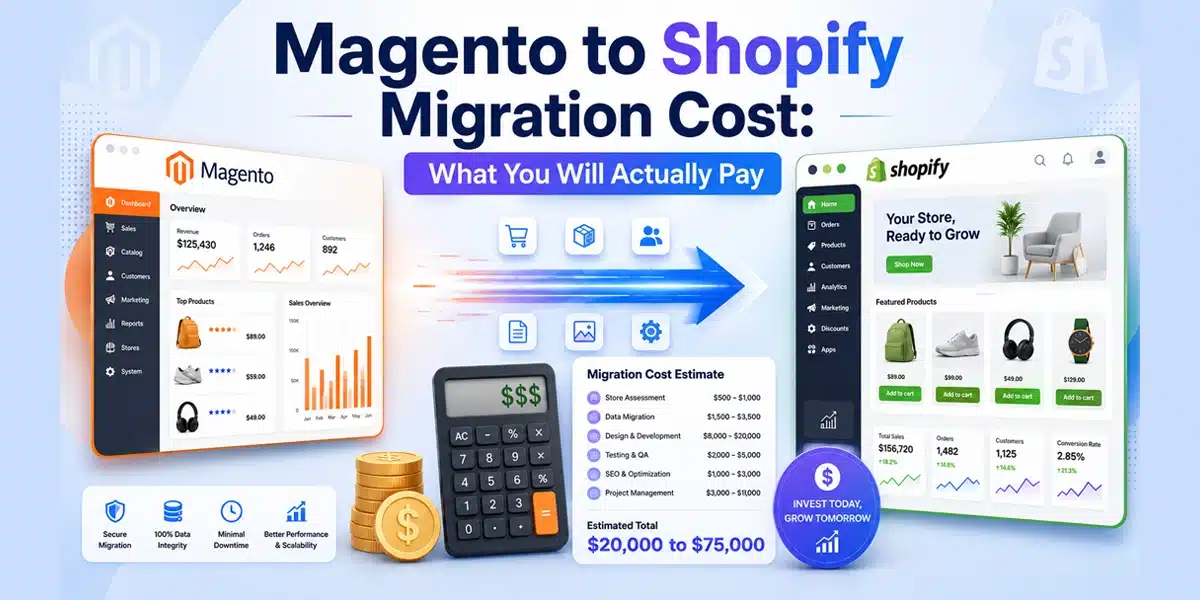
You asked three agencies what a Magento-to-Shopify migration costs. You got three numbers; the highest is five times the lowest, and none of them showed their working.
That is the real problem with this question. A migration is not a product with a price tag. It is a number of hours multiplied by an hourly rate, plus what Shopify charges you afterwards. Nobody can quote you accurately without first counting your extensions and integrations, and most published figures are just other agencies’ averages.
So this guide gives you the parts instead of a range: the current developer rate, what drives the hours up, what Shopify costs after launch, and a step-by-step method to produce your own estimate before your next call.
CommerceShop has run over 200 platform migrations since 2009 and builds on both Magento and Shopify, which is why this also covers the cases where staying put costs less.
TL;DR: Magento to Shopify Migration Cost
- A Magento to Shopify migration costs $10,000 to $15,000 for a simple store, $20,000 to $75,000 for mid-market, and $80,000 to $250,000+ for enterprise or B2B stores with ERP. Most take 8 to 24 weeks.
- It is hours times a rate. Budget $50 to $100 per hour, or $120 to $200 for senior Shopify Plus work.
- Integrations set your tier. B2B pricing, ERP, or multiple storefronts each move you up one, whatever your SKU count.
- Add the platform fee. Shopify is $39 to $399 a month. Plus starts at $2,300, about $27,600 in year one.
- Add apps. Every extension you replace becomes a subscription, typically $350 to $1,400 a month.
- Ask for hours per workstream. Only a line-by-line breakdown lets you compare proposals.
- Upgrading Magento is sometimes cheaper. Compare over three years rather than project price.
How Much Does a Magento to Shopify Migration Cost?
Published ranges cluster into three tiers. Use them to sanity-check a quote, not to set your budget.
| Store type | What it looks like | Published range |
|---|---|---|
| Simple | Small catalog, standard theme, few apps, no ERP | $10,000 to $15,000 |
| Mid-market | Some customization, several integrations | $20,000 to $75,000 |
| Enterprise or B2B | Custom pricing, ERP, multiple storefronts | $80,000 to $250,000+ |
Outside those tiers, published figures go lower and higher still: $1,500 at the bottom for a basic tool-assisted move, and up to €700,000 at the top for headless enterprise builds.
The tier you land in is decided by your integrations and business logic, not your product count. A 500-SKU B2B store with an ERP connection costs more to migrate than a 20,000-SKU consumer catalog on a stock theme.
Why Published Migration Costs Range From Under $2,000 to Over $500,000
Four reasons, and each one gives you a question to ask when comparing quotes.
Different scopes share the same label. Running products and customers through an automated tool is not the same job as rebuilding tier pricing. Both get published as “migration cost.” Ask: what exactly is included, line by line?
Currencies get mixed. Some published figures are US dollars, some euros. Guides quoting both without converting produce ranges wider than reality. Ask: is this quote in my currency, and does it include tax?
Some numbers include the platform fee, some do not. A quote excluding your Shopify subscription is not wrong, but it is not your total either. Ask: does this cover the Shopify plan, or is that separate?
Agencies publish their own client mix. An enterprise agency publishes enterprise numbers. A small-store agency publishes small ones. Ask: how many stores like mine have you migrated?
What Does a Shopify Developer Cost Per Hour?
This is the number your whole estimate is built on.
For standard Shopify migration work, budget $50 to $100 per hour with a US-based developer. The average US Shopify developer earns $52.84 per hour, and US and Canadian developers concentrate at $45 to $70. Upwork listings commonly run $30 to $95.
Two things that move you outside that band:
Specialists cost more. Senior Shopify Plus developers handling custom checkout logic, B2B catalogs, or ERP architecture typically charge $120 to $200 per hour. If your build includes any of those, budget a blended rate rather than a flat one.
Use $50 to $100 for planning. If you answer yes to B2B, ERP, or multi-store, assume part of the work bills at the specialist rate.
How to Estimate Your Magento to Shopify Migration Cost
Fifteen minutes, five steps. Do this before your next agency call.
Step 1: Count six things about your store
Open your Magento admin and write down:
- Total SKUs, and whether products use configurable options or custom attribute sets
- Active extensions. Run php bin/magento module:status for the full list, or open composer.json and count the third-party packages. The admin path Stores → Configuration → Advanced → Advanced shows module output settings but not a complete inventory
- Live integrations: ERP, PIM, CRM, tax, shipping, email, loyalty
- B2B features in use: customer groups, tier pricing, catalog price rules, quotes
- Storefronts, currencies, and warehouses
- Years of order history you actually need to keep
Step 2: Set a rough hour band
You need hours before you can multiply. Working backwards from the published cost tiers at a $75 per hour midpoint gives you a starting band:
| Store type | Implied hours | At $50/hr | At $100/hr |
|---|---|---|---|
| Simple | 130 to 200 | $6,500 to $10,000 | $13,000 to $20,000 |
| Mid-market | 270 to 1,000 | $13,500 to $50,000 | $27,000 to $100,000 |
| Enterprise or B2B | 1,000+ | $50,000+ | $100,000+ |
This is arithmetic on other agencies’ published ranges, not a quote. Use it to know whether a proposal is in the right postcode.
Step 3: Ask for hours per workstream, not one total
Send your list from Step 1 to any agency and request the quote broken out this way:
| Workstream | What it covers | What drives the hours |
|---|---|---|
| Discovery and audit | Extension inventory, integration list, custom code review, data quality check | How well your current build is documented |
| Data migration and validation | Products, variants, customers, orders and content moved, then checked against the source | SKU count, attribute complexity, order volume, years of history kept |
| Theme and storefront build | Rebuilding the frontend, since Magento themes do not transfer | Stock theme with light customization versus a custom design, and template count |
| App replacement | Finding and configuring a Shopify app for every extension you keep | Number of extensions you actually need after cleanup |
| Custom development | Anything with no app equivalent, built from scratch | How many Magento features have no Shopify app match |
| Integration rebuild | Reconnecting ERP, CRM, PIM, tax, shipping and marketing systems | Number of systems, and number of data flows each one syncs |
| SEO and redirect mapping | URL inventory, one-to-one 301s, metadata and structured data transfer | Number of indexed URLs |
| Testing and QA | Checkout, payments, refunds, tax, shipping and admin workflows | Payment methods, tax regions, and shipping rules to verify |
| Launch and post-launch support | Cutover, monitoring, and fixing what real traffic surfaces | Length of the support window, usually 30 to 60 days |
A quote that arrives as one figure cannot be compared to anything. Ask for these nine lines before you compare proposals.
Step 4: Multiply and add the platform fee
Hours × your blended rate, plus twelve months of the Shopify plan you will be on. That is your first-year total.
Step 5: Adjust for the three multipliers
B2B pricing, ERP integration, and multiple storefronts each add significant hours. Across every published breakdown, a yes to any one of them moves a store up a tier. A yes to all three puts you in the enterprise band regardless of catalog size.
Your estimate will not be exact. It will be close enough to tell whether a quote is reasonable, and specific enough that a good agency will engage with it.
Magento B2B to Shopify Migration Cost: Why It Runs Higher
If you sell to businesses, these five things are rebuilds, not transfers. Each one is hours.
Customer-specific pricing. Magento tier pricing and catalog price rules become Shopify B2B catalogs and company profiles. The logic has to be remapped account by account.
Quote-to-order workflows. Shopify handles quotes through apps or custom development. Magento’s built-in flow rarely maps one to one, so expect either a compromise or custom work.
Payment terms and credit. Net terms and payment on account work differently on Shopify. Confirm your specific terms are supported before you commit.
Multi-warehouse inventory. Magento’s inventory sources become Shopify locations, and your allocation rules need rebuilding against that model.
Catalog visibility by customer group. Rules determining who sees which products get rebuilt as B2B catalog assignments.
If this is your store, get these scoped separately from the catalog work. Our B2B and manufacturing team prices them as their own workstream because they behave nothing like a data migration.
How Much Does ERP Integration Add to a Shopify Migration?
Your Magento ERP connector does not transfer. It is rebuilt. Three things set the price:
Which ERP you run. NetSuite, SAP, Odoo, Epicor, Infor, and Acumatica differ in connector availability. Some have mature pre-built Shopify connectors. Others need custom middleware, which is a different scale of work.
How many data flows you sync. Orders alone is straightforward. Orders plus inventory plus customers plus pricing plus invoices is a project in its own right.
Pre-built or custom. Pre-built connectors carry a monthly subscription and lower build hours. Custom integration costs more upfront and needs ongoing maintenance.
Scope and price this before you agree a migration date. ERP work depends on a third party’s availability as much as your developer’s, which makes it the most common cause of slipped timelines.
How Much Does Shopify Cost After You Migrate?
The migration is one-time. This bill repeats, and it belongs in your comparison.
| Plan | Monthly cost | Online card fee |
|---|---|---|
| Basic | $39, or $29 billed annually | 2.9% + 30¢ |
| Grow | $105, or $79 billed annually | 2.7% + 30¢ |
| Advanced | $399, or $299 billed annually | 2.5% + 30¢ |
| Plus | From $2,300 on a 3-year term, $2,500 on 1-year | About 2.15% + 30¢ |
Add three things on top:
Apps. Mid-market brands commonly spend $350 to $1,400 per month. Every Magento extension you replace with an app becomes a subscription. Count your extensions to estimate this.
Third-party gateway surcharge. Using a gateway other than Shopify Payments adds roughly 0.2% to 2.0% on top of that gateway’s own fees.
Plus revenue share. Above a high GMV threshold, Plus billing switches from the flat fee to a percentage of revenue, capped at $40,000 per month. Below the threshold, you pay the flat rate.
Most stores do not need Plus. Advanced covers standard requirements at a fraction of the cost. Plus becomes worth evaluating around $1M to $2M in annual revenue, or earlier if you need B2B catalogs, multiple storefronts, or custom checkout logic.
How Much Does a Magento to Shopify Plus Migration Cost?
Migrating to Plus rather than a standard plan costs more for two reasons, and neither is the Shopify fee.
First, businesses that need Plus usually need it because they have B2B catalogs, multiple storefronts, or custom checkout logic, and those are the same features that push migration hours up. Published Magento to Shopify Plus ranges run $20,000 to $250,000+.
Second, the platform fee itself starts at $2,300 per month, which adds roughly $27,600 to your first-year total before any development work.
If you are considering Plus only for the migration and not for a feature you need, price Advanced first.
How Long Does a Magento to Shopify Migration Take?
Published timelines disagree as much as the costs:
- Simple to moderate builds: 4 to 16 weeks
- Typical range across 200+ documented migrations: 8 to 24 weeks
- Complex B2B and ERP builds: 12 to 28 weeks
The consistent pattern: a catalog move runs weeks, anything with B2B logic or ERP runs months. The driver is how many systems have to talk to each other on launch day, not how many products you sell.
Add buffer for what you do not control: vendor compatibility confirmations, ERP partner availability, and your own team’s review cycles. These are routinely left out of project plans and routinely cause the delay.
The Hidden Costs Most Magento to Shopify Quotes Miss
Five real costs that usually surface after launch rather than in the proposal.
Customer password resets. Shopify cannot import Magento password hashes, so every customer resets. Budget for a reset email campaign, a support spike in week one, and some churn among lapsed accounts. Plan the email before launch, not after.
App subscriptions. A one-time Magento extension licence becomes a recurring app fee. Ten extensions can become a meaningful monthly line.
Order history. Moving historical orders often needs API work or a paid tool rather than a standard import. Decide how many years you need before you pay to move all of them.
Staff retraining. Your team knows the Magento admin. Allow time for customer service and fulfilment to learn a different one, and schedule it before cutover.
Cancelled Magento costs you forget to cancel. Hosting, extension subscriptions, and monitoring tools often run for months after launch. Put a cancellation date in the project plan.
What Should Be Included in a Magento to Shopify Migration Quote?
Check every proposal against this. A quote missing several of these is not cheaper, it is smaller.
- Hours broken out per workstream
- A named target Shopify plan, so the platform fee is accounted for
- A list of which Magento extensions get replaced, rebuilt, or dropped
- Each integration named individually, with an owner assigned
- A redirect map and SEO plan as a named deliverable
- Defined QA scope covering checkout, payments, tax, and shipping
- What happens to historical order data
- A rollback plan if launch goes wrong
- Post-launch support terms, and how long they last
- Written confirmation that you own the store, theme code, and any custom apps
Migration Tools or a Developer: Which Costs Less?
Automated tools like Cart2Cart and Matrixify move products, customers, and orders for a fraction of a developer’s fee. For a small store with a clean catalog and no custom logic, they can do the job.
They stop being enough when your store has configurable products with complex attribute sets, customer-group or tier pricing, custom checkout logic, ERP or PIM connections, or order history in a structure the tool does not support.
The realistic answer for most stores is both. Use a tool for the bulk data move, then pay a developer for attribute mapping, validation, the storefront build, and integrations. That is usually cheaper than either extreme.
One thing to budget for either way: validation. Products appearing in Shopify does not mean the migration worked. Check variant mapping, pricing, inventory counts, and a sample of orders against the source before you go live.
Is It Cheaper to Upgrade Magento or Migrate to Shopify?
Worth asking first, because standard support for Magento 2.4.6 ends on August 11, 2026, which is what is driving most of these searches.
Upgrading usually costs less when your customizations still earn their keep, your integrations are deeply tied to Magento, and your team knows how to run it. An upgrade keeps your extensions, data structures, and business logic. A migration rebuilds all three.
Migrating tends to pay off when maintenance spend has outgrown what the platform returns, when routine changes need developer time you do not have, or when you were facing a rebuild anyway.
Compare on three-year total cost, not project price:
- Staying on Magento: upgrade project + 3 years of hosting, security patching, extension licences, and developer time
- Moving to Shopify: migration project + 3 years of subscription, apps, and transaction fees
Run both with your own numbers. Our Magento and migration teams scope both paths so you can compare like for like.
Magento vs Shopify: What Each Costs to Run
The running costs sit in different places, which is why project price alone misleads.
| Self-hosted Magento | Shopify | |
|---|---|---|
| Platform fee | None for Open Source; Adobe Commerce licensed | $39 to $2,300+ per month |
| Hosting | Yours, and scales with traffic | Included |
| Security patching | Yours, on Adobe’s release schedule | Handled by Shopify |
| Extensions and apps | One-time licences plus updates | Recurring app subscriptions |
| Developer rate | Magento specialists, a shrinking pool | $50 to $100 per hour, wider pool |
| Transaction fees | Gateway only | Gateway plus Shopify’s rate |
| Upgrade cycle | Every few years, as a project | Continuous, handled by Shopify |
Published estimates of annual self-hosted Magento running cost vary widely, from $50,000 to $150,000 to $80,000 to $400,000 for larger stores. The spread is wide enough that you should use your own invoices rather than anyone’s benchmark. Add up last year’s hosting, patching, extension licences, and developer time, then compare it against a Shopify plan plus your app estimate.
When You Should Not Migrate From Magento to Shopify
Four situations where staying is the better answer.
You rebuilt on Magento 2 recently. If the build is current and working, you would be paying to replace something that is not broken.
Your B2B workflows are genuinely complex. Deep quote-to-order processes, contract pricing across hundreds of accounts, and multi-warehouse allocation are areas where Magento still holds an advantage.
Your catalog depends on Magento’s attribute model. Very large catalogs with deep attribute logic need careful remapping, and sometimes compromise.
The driver is frustration, not economics. A poor agency relationship is cheaper to fix than a replatform.
How to Protect SEO and Revenue During the Move
Three actions, in order.
Before development starts, crawl the existing store and export every indexable URL with its organic traffic and revenue. This is your protection list. Build one-to-one 301 redirects from it. Avoid bulk-redirecting removed pages to the homepage, which discards the link value you are trying to keep.
During the build, carry metadata, canonical tags, and structured data across as a named deliverable with an owner. None of it migrates automatically.
For eight weeks after launch, watch rankings, organic traffic, crawl errors, and conversion rate against your pre-launch baseline. Problems here appear gradually rather than on day one, which is why they get missed.
When we migrated Cannanumb from Magento to Shopify, the store was running an outdated Magento 1.x with repeated outages while organic search drove a large share of revenue. Protecting that traffic through the move was the constraint that shaped the whole project.
Magento to Shopify Migration Cost FAQs
Can I get a fixed price for a Magento to Shopify migration? Yes, after a paid discovery phase. Fixed pricing offered before anyone has audited your extensions and integrations usually means the scope was guessed, and guessed scope becomes change requests later.
Does Shopify charge anything for the migration itself? No. Your costs are the developer or agency, any migration tools, and your Shopify subscription from the point you start building.
Can I run Magento and Shopify at the same time during the move? Yes, and most migrations do. The Magento store stays live while the Shopify one is built and tested. You switch at DNS cutover, usually with a final data sync immediately before.
How much does it cost to move only my product data? This is the cheapest part of any migration. Products, customers, and orders can move with an automated tool. The cost sits in everything attached to that data: pricing rules, integrations, and custom logic.
What happens to my Magento extension licences? They do not transfer and are not refundable. Cancel recurring extension subscriptions after launch, since these are commonly left running for months.
Do I need to migrate all my order history? Usually not. Most businesses need two to three years for customer service and reporting. Moving ten years costs meaningfully more. Export the rest to CSV and archive it.
Will my Magento theme work on Shopify? No. Themes are platform-specific and the storefront is rebuilt. Budget for either a Shopify theme with customization or a custom build.
Is Shopify cheaper than Magento? Usually on running costs, because hosting, patching, and upgrades are included. Not always on transaction fees or apps, which are recurring where Magento extension licences are often one-time. Compare over three years, not one.
Can I migrate from Magento 1 to Shopify directly? Yes. You do not need to upgrade to Magento 2 first. Magento 1 has been unsupported since 2020, so a direct move to Shopify is common and avoids paying for two projects.
Who owns the Shopify store when the project ends? You should. Confirm in writing before signing that the store, theme code, and any custom apps belong to you.
Get a Fixed-Scope Migration Estimate
CommerceShop has delivered 200+ platform migrations and 500+ Shopify stores since 2009, working across both Magento and Shopify. That means we will tell you when upgrading is the cheaper answer.
A migration assessment gives you your extension and integration inventory, hours per workstream, a three-year cost comparison against staying on Magento, and an SEO protection plan.

